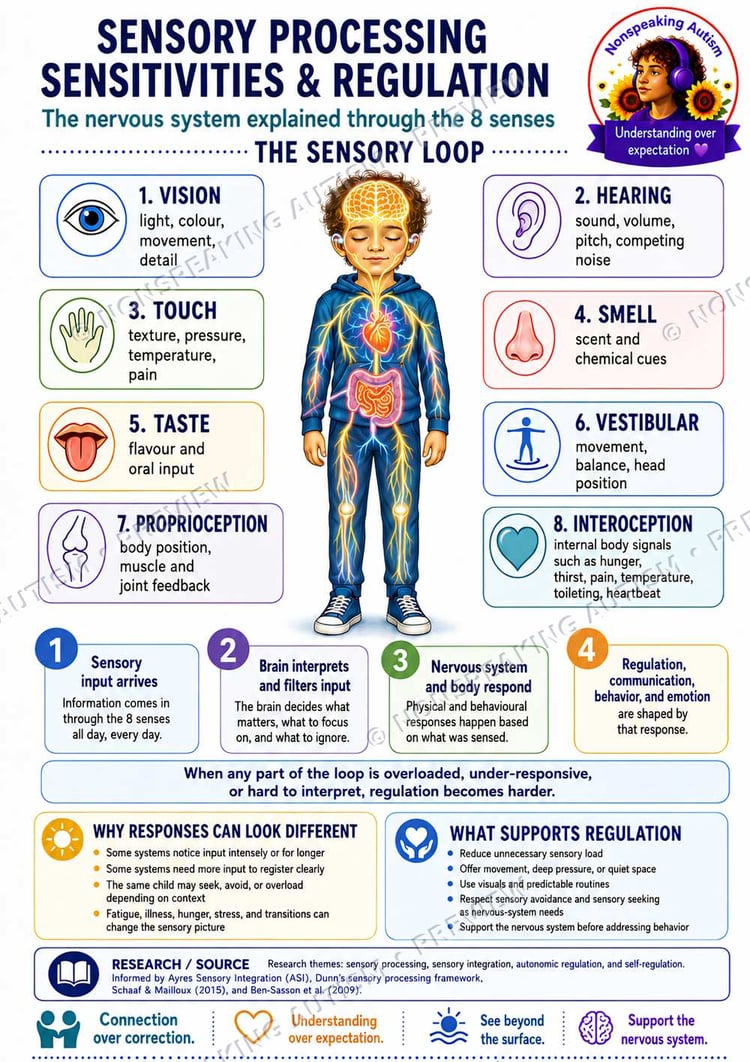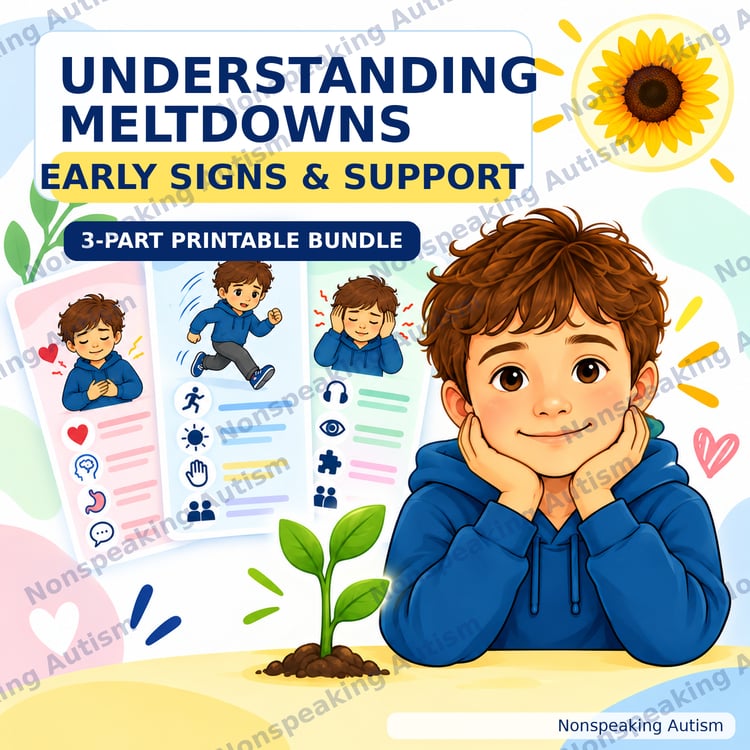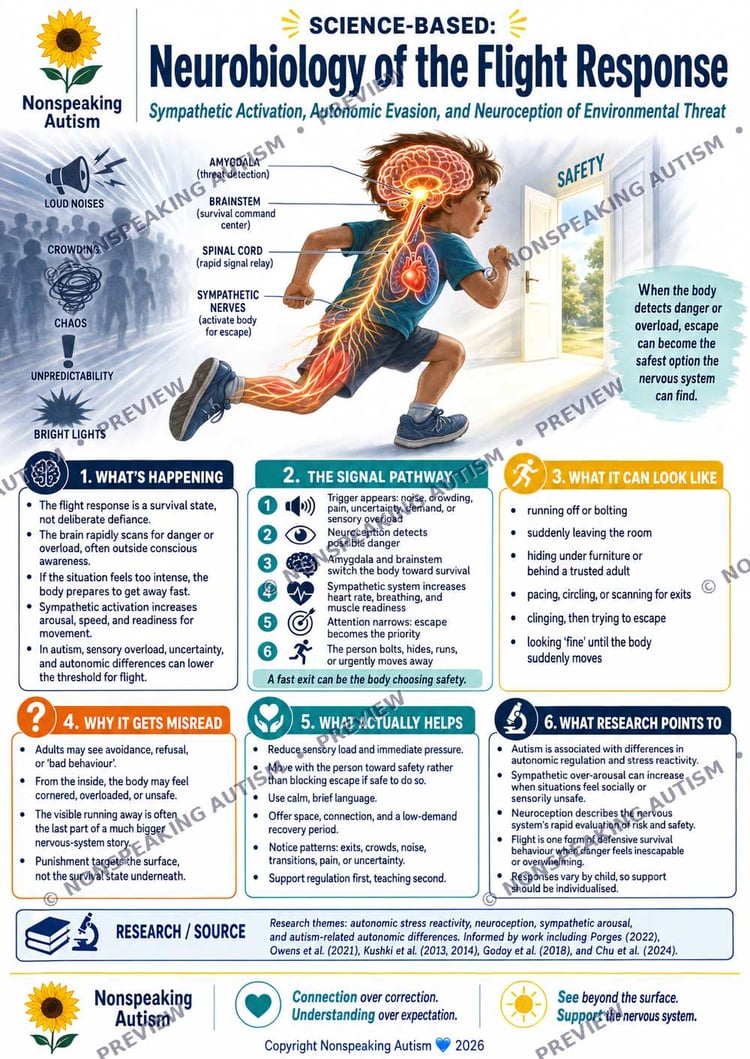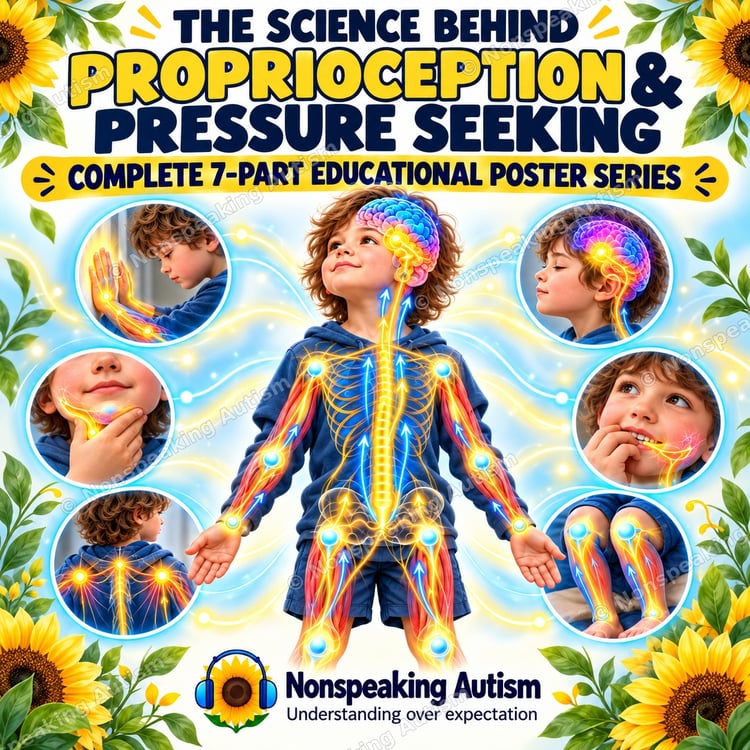

Sensory Decoding — Sample Sensory Toolkit List
Sensory Decoding — Sample Sensory Toolkit List
Low-Cost & Everyday Ideas to Support Regulation, Comfort, Participation and Wellbeing
Sensory support does not have to mean an expensive room filled with specialist equipment.
Sometimes the most useful supports are the simplest ones: ear defenders, a quiet corner, a familiar texture, movement, a visual schedule, something safe to chew, a comfortable place to decompress, or access to a trusted adult.
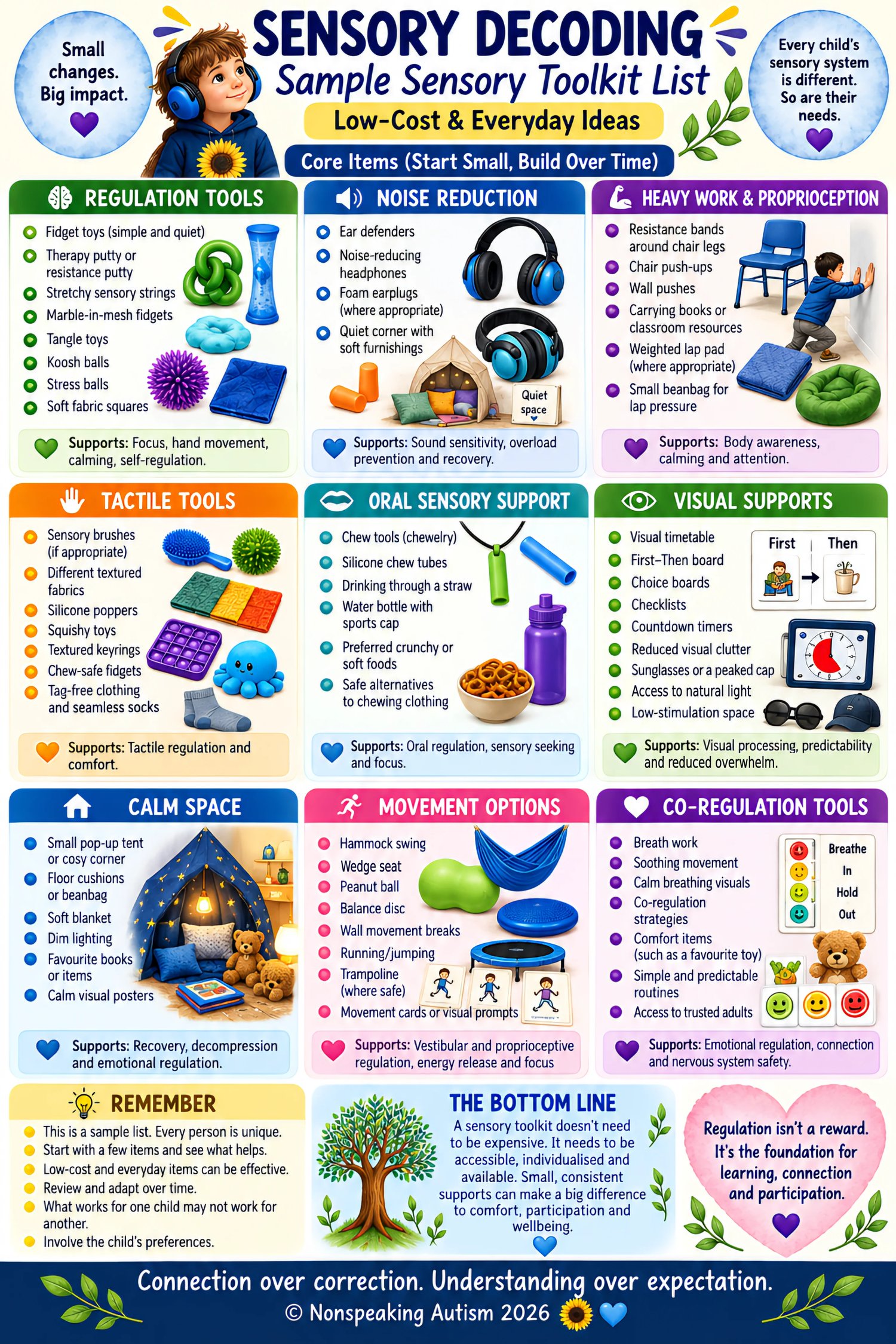
The Sensory Decoding — Sample Sensory Toolkit List is a practical educational resource designed to help families, caregivers, educators and professionals explore a range of low-cost and everyday sensory-support ideas.
It brings together examples across multiple sensory and regulation areas while keeping one principle at the centre:
Every child’s sensory system is different.
So are their needs.
This is not a shopping list where every item needs to be purchased.
It is a starting point for discovering:
What helps this individual person feel more comfortable, regulated and able to participate?
Small changes. Big impact. 💜
🧠 What Is a Sensory Toolkit?
A sensory toolkit is simply a collection of supports, environmental adjustments and strategies that may help a person manage sensory input, regulate, recover or participate more comfortably.
It does not need to come in a special box.
It does not need to contain expensive equipment.
And there is no universal “autism sensory kit.”
One person may benefit from noise reduction but dislike fidget toys.
Another may seek movement but avoid certain textures.
Someone else may find visual predictability more helpful than any physical sensory tool.
The goal is to build support around the individual sensory profile, rather than assuming that every autistic person needs the same things.
🌱 Start Small — Build Over Time
One of the most important messages in this resource is:
You do not need everything on this poster.
Start with a few ideas that relate to an identified need.
Observe what happens.
Keep what genuinely helps.
Change or remove what does not.
Then build gradually if necessary.
This approach can help families avoid buying large amounts of sensory equipment before knowing whether it is actually useful for their child.
What This Poster Explores
The toolkit is organized into nine practical areas of sensory and regulation support:
🧠 Regulation Tools
🔊 Noise Reduction
💪 Heavy Work & Proprioception
✋ Tactile Tools
👄 Oral Sensory Support
👁️ Visual Supports
🏠 Calm Space
🏃 Movement Options
💜 Co-Regulation Tools
Each section provides examples that can be explored according to the person's preferences, needs, age, safety and environment.
🧠 1. Regulation Tools
Simple hand-based or tactile items may provide useful sensory input for some people.
Examples on the poster include:
fidget toys
therapy or resistance putty
stretchy sensory strings
marble-in-mesh fidgets
tangle toys
Koosh-style balls
stress balls
soft fabric squares
For some individuals, these may support hand movement, focus, calming or self-regulation.
But a fidget is only useful if it actually helps the person using it.
A child should not be expected to use a sensory tool simply because it has been labelled “sensory.”
🔊 2. Noise Reduction
Sound can be a significant source of sensory load for some autistic people.
The poster suggests options such as:
ear defenders
noise-reducing headphones
foam earplugs where age- and safety-appropriate
a quieter corner with comfortable furnishings
These may help with sound sensitivity, overload prevention or recovery.
Noise reduction does not have to mean removing all sound.
The aim may simply be to make auditory input more manageable.
💪 3. Heavy Work & Proprioception
Activities involving pushing, pulling, carrying and resistance provide proprioceptive input.
Examples include:
resistance bands around chair legs
chair push-ups
wall pushes
carrying books or classroom resources
a weighted lap pad where appropriate
a small beanbag for lap pressure
Some people find this type of input regulating or helpful for body awareness and attention.
The important principle is individual response.
Heavy-work activities should be appropriate for the person's age, abilities and physical safety, and weighted items should be used thoughtfully rather than automatically.
✋ 4. Tactile Tools
Touch and texture can be soothing, interesting or highly uncomfortable depending on the person.
Possible options include:
sensory brushes where appropriate
different textured fabrics
silicone poppers
squishy toys
textured keyrings
chew-safe fidgets
tag-free clothing
seamless socks
These ideas may help explore tactile regulation and comfort.
Sometimes the most effective sensory support is not adding a new tool at all.
It may simply be removing an irritating clothing tag, changing a fabric or allowing someone to wear clothing they can comfortably tolerate.
👄 5. Oral Sensory Support
Some people seek oral sensory input through chewing, biting, crunching, sucking or mouthing objects.
The poster includes examples such as:
purpose-designed chew tools or chewable jewelry
silicone chew tubes
drinking through a straw
a water bottle with a sports cap
preferred crunchy or soft foods
safe alternatives to chewing clothing
The aim is to understand the sensory need underneath the behaviour and, where necessary, provide safer alternatives.
Any chewable item should be appropriate for the individual and used with relevant safety considerations and supervision.
Persistent or unusual chewing, swallowing of non-food items, feeding difficulties, choking risk or dental concerns may require appropriate professional assessment.
👁️ 6. Visual Supports
Sensory accessibility is not only about touch, sound or movement.
Visual environments can also influence regulation and processing.
The poster suggests:
visual timetables
First–Then boards
choice boards
checklists
countdown timers
reducing visual clutter
sunglasses or a peaked cap where appropriate
access to natural light
lower-stimulation spaces
These supports may help with visual processing, predictability and reducing overwhelm.
Visual supports can also reduce reliance on repeated spoken instructions.
🏠 7. Creating a Calm Space
A calm space does not need to be a specialist sensory room.
It might simply be a small, predictable place where someone can reduce demands and decompress.
Ideas include:
a small pop-up tent
a cozy corner
floor cushions or a beanbag
a soft blanket
dimmed lighting
favorite books or familiar items
calming visual resources
The purpose should not be punishment or isolation.
A calm space works best when it is understood as accessible support — somewhere a person can regulate, decompress and recover.
🏃 8. Movement Options
Movement can be an important form of regulation for some people.
Examples on the poster include:
a hammock swing
wedge seating
a peanut ball
a balance disc
wall movement breaks
running or jumping
a trampoline where safe
movement cards or visual prompts
Different forms of movement provide different kinds of sensory input.
Some people actively seek movement, while others may find particular types of movement uncomfortable or disorienting.
Again, individual preference matters.
Movement opportunities should be safe, appropriate and adapted to the person's physical abilities and environment.
💜 9. Co-Regulation Tools
Not every regulation tool is an object.
Sometimes the most important support is another person.
The poster includes:
breath work
soothing movement
calm breathing visuals
co-regulation strategies
comfort items
simple and predictable routines
access to trusted adults
A calm, responsive adult can help create predictability and emotional safety.
Co-regulation is not about forcing someone to become calm on command.
It is about offering connection, support and reduced pressure while the person moves through distress or overload.
💙 Regulation Is Not a Reward
Access to helpful regulation strategies should not automatically depend on completing work, demonstrating expected behaviour or earning them through a reward system.
If headphones, movement, a quiet space or another support helps someone remain regulated and able to participate, it may function as an access need rather than a prize.
That is why one of the central messages of this resource is:
Regulation isn't a reward.
It's the foundation for learning, connection and participation.
🌻 Build the Toolkit Around the Person
A useful sensory toolkit is not the one with the most equipment.
It is the one that contains the right supports for the individual.
Consider:
What does the person actively seek?
What do they avoid?
What environments seem hardest?
What happens before overload?
What naturally helps them recover?
Which tools do they independently choose?
Does the strategy actually improve comfort or participation?
Does the person want to use it?
These observations can be more useful than simply collecting items labelled as “sensory.”
🔄 Review and Adapt
Sensory needs can change.
A strategy that works at home may not work at school.
Something helpful during a quiet day may not be enough during a particularly demanding one.
Preferences may also change with age, environment, fatigue, stress, illness and other factors.
A sensory toolkit should therefore be flexible rather than fixed.
Try.
Observe.
Adapt.
And involve the person wherever possible.
🔬 Research-Informed
This resource reflects established understanding that sensory-processing differences are common in autism and may affect everyday comfort, regulation and participation.
However, evidence for specific sensory interventions and individual sensory tools varies, and a tool being widely used does not mean it will be effective for every autistic person.
This poster should therefore be understood as a sample list of ideas, not a prescribed treatment programme.
Where sensory difficulties substantially affect daily life, individualized guidance from an appropriately qualified professional, such as an occupational therapist where relevant, may be helpful.
Individualized support matters more than building the biggest toolkit.
Yes. For the Sensory Decoding – Sample Sensory Toolkit List, I’d add a proper Selected References / Evidence Base section to the Payhip description. I checked the citations, including the two papers already used on your related sensory poster.
📚 Selected References & Evidence Base
MacLennan, K., O’Brien, S., & Tavassoli, T. (2022). In Our Own Words: The Complex Sensory Experiences of Autistic Adults. Journal of Autism and Developmental Disorders, 52, 3061–3075. DOI: 10.1007/s10803-021-05186-3.
This qualitative research explores autistic adults’ own experiences of sensory hyperreactivity, hyporeactivity and sensory seeking, supporting the importance of recognizing that sensory experiences are complex and highly individualized. DOI
Kyriacou, C., Forrester-Jones, R., & Triantafyllopoulou, P. (2023). Clothes, Sensory Experiences and Autism: Is Wearing the Right Fabric Important? Journal of Autism and Developmental Disorders, 53, 1495–1508. DOI: 10.1007/s10803-021-05140-3.
This study examines autistic people's experiences of clothing and tactile sensitivity, supporting the poster's emphasis on considering individual responses to fabrics, textures and clothing. Springer
Ismael, N., Lawson, L. M., & Hartwell, J. (2018). Relationship Between Sensory Processing and Participation in Daily Occupations for Children With Autism Spectrum Disorder: A Systematic Review of Studies That Used Dunn's Sensory Processing Framework. American Journal of Occupational Therapy, 72(3), 7203205030p1–7203205030p9. DOI: 10.5014/ajot.2018.024075.
This systematic review found evidence that sensory processing can have a meaningful impact on autistic children's participation in everyday activities, while also noting limitations in the available evidence. PubMed
Watling, R., & Hauer, S. (2015). Effectiveness of Ayres Sensory Integration® and Sensory-Based Interventions for People With Autism Spectrum Disorder: A Systematic Review. American Journal of Occupational Therapy, 69(5). DOI: 10.5014/ajot.2015.018051.
This review is particularly useful for keeping the resource balanced: it reported moderate evidence for Ayres Sensory Integration, while findings for individual sensory-based interventions were mixed. PubMed
Schoen, S. A., Lane, S. J., Mailloux, Z., May-Benson, T., Parham, L. D., Smith Roley, S., & Schaaf, R. C. (2019). A Systematic Review of Ayres Sensory Integration Intervention for Children with Autism. Autism Research, 12(1), 6–19. DOI: 10.1002/aur.2046.
American Academy of Pediatrics, Council on Children with Disabilities et al. (2012). Sensory Integration Therapies for Children With Developmental and Behavioral Disorders. Pediatrics, 129(6), 1186–1189. DOI: 10.1542/peds.2012-0876.
The AAP advises families that evidence for sensory-based therapies has historically been limited and inconclusive and recommends evaluating whether an intervention is actually helping the individual child. This is an important citation for your poster because it supports your wording “start with a few items and see what helps” rather than presenting every sensory product as evidence-based treatment. American Academy of Pediatrics
Hyman, S. L., Levy, S. E., Myers, S. M., & Council on Children with Disabilities, Section on Developmental and Behavioral Pediatrics. (2020). Identification, Evaluation, and Management of Children With Autism Spectrum Disorder. Pediatrics, 145(1), e20193447. DOI: 10.1542/peds.2019-3447.
The AAP notes that sensory symptoms are recognized within autism and can affect children's everyday functioning, while also cautioning that evidence does not support the general use of every commonly used sensory-based intervention. American Academy of Pediatrics
🔬 Evidence Note
This resource is research-informed, not a prescribed sensory-treatment programme. Research supports the importance of recognizing autistic sensory differences and their potential effects on everyday participation. However, evidence varies considerably for individual sensory tools and interventions. Some commonly used items — including weighted products, brushing, swings and specialized seating — should therefore not be described as universally effective or necessary for autistic children.
👨👩👧 Who Is This Resource For?
This poster may be useful for:
- autistic children and young people
- parents and caregivers
- families beginning to explore sensory support
- teachers
- classroom and support staff
- special-education and SEND professionals
- occupational therapists
- speech and language professionals
- early-years practitioners
- support workers
- inclusion teams
- autism and disability organizations
- sensory-friendly settings
- professional-development and staff-training environments
It can be used at home, school, clinics and other support environments as a practical visual reference.
📦 What You Receive
Your purchase includes:
1 × Sensory Decoding — Sample Sensory Toolkit List poster
1 × high-resolution PDF
The purchased resource is supplied clear and without the promotional preview watermark shown in the Payhip listing image.
Watermarks visible in promotional images are used for preview and copyright protection only and are not present on the purchased file.
Digital download only — no physical product will be shipped.
⚠️ Important Safety & Educational Disclaimer
This poster is a research-informed educational resource and is not medical advice, diagnosis, occupational-therapy assessment, treatment or an individualized sensory plan.
Every person's sensory profile, physical abilities, communication and support needs are different.
Not every item or activity shown will be suitable for every person.
Particular care should be taken with items that may present choking, swallowing, strangulation, hearing, balance, fall or other safety risks. Weighted products, movement equipment, chew tools and similar supports should be selected and used appropriately for the individual, following relevant product safety information and professional guidance where needed.
Sensory brushing or other specialized sensory techniques should not be introduced as a generic autism strategy without appropriate individualized consideration.
Significant, sudden, unusual or prolonged changes in sensory tolerance, eating, behaviour, communication, responsiveness, balance or functioning may have causes other than sensory processing and should receive appropriate professional or medical assessment where relevant.
💛 The Message Behind the Resource
Families can sometimes feel as though supporting sensory needs requires buying an entire room of specialist equipment.
It doesn't.
A sensory toolkit might begin with:
one pair of ear defenders
one quiet corner
one familiar texture
one visual schedule
one safe movement opportunity
or simply:
one adult who understands why the person needs a break.
The aim is not to collect sensory products.
The aim is to discover what genuinely helps this person.
Start small.
Watch what helps.
Listen to preferences.
Adapt over time.
And remember:
What works for one child may not work for another.
A sensory toolkit doesn't need to be expensive. It needs to be accessible, individualized and available.
Small, consistent supports can make a big difference to comfort, participation and wellbeing.
Small changes. Big impact. 💜
Connection over correction. Understanding over expectation.
©️ Copyright & Permitted Use
Copyright © 2026 Nonspeaking Autism. All rights reserved.
Purchase permits use for personal, home, classroom, school, clinic or individual professional educational purposes.
The digital file may not be resold, redistributed, file-shared, uploaded to other websites or marketplaces, commercially reproduced, altered for resale or incorporated into another product for sale without permission.