


Payhip Vs Etsy: Which is Better in 2026?
Last updated: May 13, 2026
When it comes to selling digital products online, there are many ecommerce platforms to choose from. Two popular choices are Payhip and Etsy. Etsy is a well-known marketplace where you can sell handmade goods. Payhip is a website builder that allows you to sell digital products with ease. In this article, we’ll examine the key differences between Payhip and Etsy to help people pick the platform that’s best suited to their niche, budget, and more.
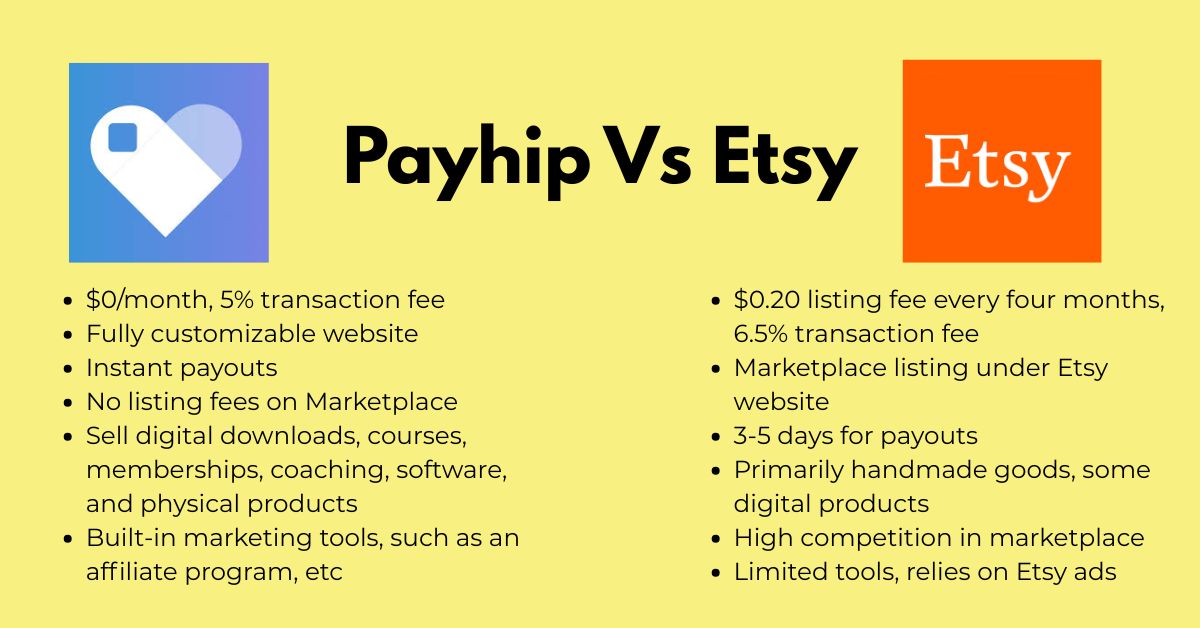
| Feature | Payhip | Etsy | Best Choice |
|---|---|---|---|
| Best For | Digital products, courses, memberships, coaching, software, and physical products | Handmade and aesthetic physical products (some digital products) | Payhip for digital creators |
| Pricing | Free plan (5% fee) Optional subscription to reduce fees |
$0.20 listing fee + 6.5% transaction fee + processing fees | Payhip (lower and predictable costs) |
| Brand Ownership | Fully customizable website and brand | Marketplace listing under Etsy brand | Payhip |
| Product Types | Digital downloads, courses, memberships, coaching, software, physical products | Primarily physical handmade goods, limited digital capabilities | Payhip |
| Payout Speed | Instant payouts via Stripe & PayPal | 3–5 days (or longer delays for new sellers) | Payhip |
| Marketing Tools | Built-in tools: affiliates, coupons, email lists, upsells, referrals | Limited built-in tools, relies on Etsy ads | Payhip |
| Marketplace | Payhip Marketplace (no listing fees) | Massive marketplace with high competition | Tie (visibility vs competition) |
| Fees on Listings | No listing fees | $0.20 per listing (expires every 4 months) | Payhip |
| Competition | Lower competition, niche-based selling | Extremely high competition, including dropshippers | Payhip |
| Ease of Use | Beginner-friendly, no coding required | Easy to start, but harder to scale | Tie |
| Customer Support | Responsive, seller-focused support | Often slow, policy-heavy, buyer-first | Payhip |
Payhip Overview

Payhip is a great platform for digital product sellers looking to build a fully customizable brand. Sellers benefit from a platform with low fees and a free plan that only charges you when you’ve made a sale instead of requiring an upfront payment. Payhip offers an extensive collection of features, from product-specific features to marketing tools, that make selling online even easier. Like Etsy, Payhip also has a marketplace called Payhip Marketplace where you can sell your products with no listing fees.
Payhip Pros
1. Own your brand
Unlike Etsy, Payhip lets you create a fully customizable brand. This website builder lets you use a theme to easily create a website design, but every aspect can be customized. You’ll be able to add your own logo, announcement bar, and payment and social media icons. You’ll also be able to pick the color scheme, aspect ratio, and so much more. With the full customization within your control, sending emails, running retargeting ads, and other marketing aspects will be much easier for you, as you own your own site rather than a listing on a site like Etsy.
2. Low fees
Across all ecommerce platforms, Payhip is known to be one of the most affordable. With a 5% transaction fee on the forever free plan, you won’t have to worry about paying for anything else. You can also choose a monthly subscription and avoid transaction fees once your sales reach a certain threshold. Overall, Payhip is a cost-effective way to sell digital and physical products online. The best part about these low fees is that you can have predictable expenses. You always know your costs per sale. There are no hidden fees and no expiration date on listings. Plus, Payhip hasn’t increased its fees in years, and there are no plans to do so either.
3. Sell anything with ease
Payhip is the ultimate platform for selling digital and physical products. However, unlike traditional ecommerce platforms or even Etsy, Payhip offers specialized features for particular digital products. For example, if you choose to sell online courses, you’ll access features like a beautiful course player, quizzes, surveys, embeds, drip content, and more. You can also sell piracy-safe digital downloads with PDF stamping. If you choose to sell software, you can generate license keys or even upload your own. Coaching, memberships, and physical products are other types of products you can sell.
4. Instant payouts with Stripe and PayPal
Payhip offers instant payouts when you use Stripe or PayPal as your payment method. Etsy, on the other hand, takes 3-5 business days to deposit funds in sellers’ accounts. Sellers will need to choose whether to receive daily, weekly, or monthly payments. However, Etsy delays payment for new sellers on its platform. Some sellers may have to wait up to 180 days for payment. For an Etsy seller to receive a payout in 30 minutes, they will need to pay a 1% fee for an instant-like payout.
5. Free complex marketing tools
Payhip offers complex marketing tools that are easy to use, helping you market your store. Some of the marketing tools you’ll be free to use include: coupons, affiliate program, mailing lists, cross-selling, upselling, referrals, and customer reviews. Most ecommerce platforms don’t have built-in affiliate programs you can launch; they usually have third-party tools. Plus, with Payhip, you set the terms of your affiliate program and how much you’re willing to pay for a sale they generate. Etsy pays affiliates 4% per sale but charges sellers 12% or 15% as it’s considered an ad fee. On Payhip, you can set the terms you pay your affiliates without needing to charge for getting affiliate sales.
6. Sell unlimited products
On Payhip, you can sell an unlimited number of products. This means there are no additional fees for adding more products to your online store. Some ecommerce platforms charge higher monthly subscription fees to add more products. Etsy charges $0.20 every four months per listing. If a product sells occasionally but not frequently, you can keep it on your Payhip store without losing money. On Etsy, products that don’t sell at all leave you in a deficit as they cost more than they bring in due to the listing fees. On Payhip, you will never lose money if you don’t make a sale. With unlimited products, you can keep all products in your store without paying until you make a sale.
7. Payhip Marketplace
Payhip also has Payhip Marketplace, where you can sell products in an online marketplace just like Etsy. To be accepted into the marketplace, you need to have made at least $10 in sales. Plus, you need to be approved by a Payhip staff member to ensure you are in compliance with the terms of service. There’s no listing fee for the marketplace. You’ll be charged the same 5% transaction fee even when you make sales from Payhip Marketplace.
Payhip Cons
1. Payhip only allows one store per email
One downside of Payhip is that you can only create one store per email address. If your goal is to sell multiple products across multiple stores, you will need to create a new email for each store. This can be problematic if you want to focus on a singular niche. However, you can add unlimited products to your website, so having products from multiple niches in one store is accepted.
Sell Digital Products with Payhip
No monthly fees. No tech headaches.
Etsy Overview
Etsy is a marketplace with an increasing number of sellers but declining buyers. The platform is known for its fierce competition, rising costs, and problematic policies. Sellers who have created original products are sometimes delisted for copyright infringement, even though their products are their own creations and not closely similar to the competing product.
Etsy Pros
1. Massive global marketplace
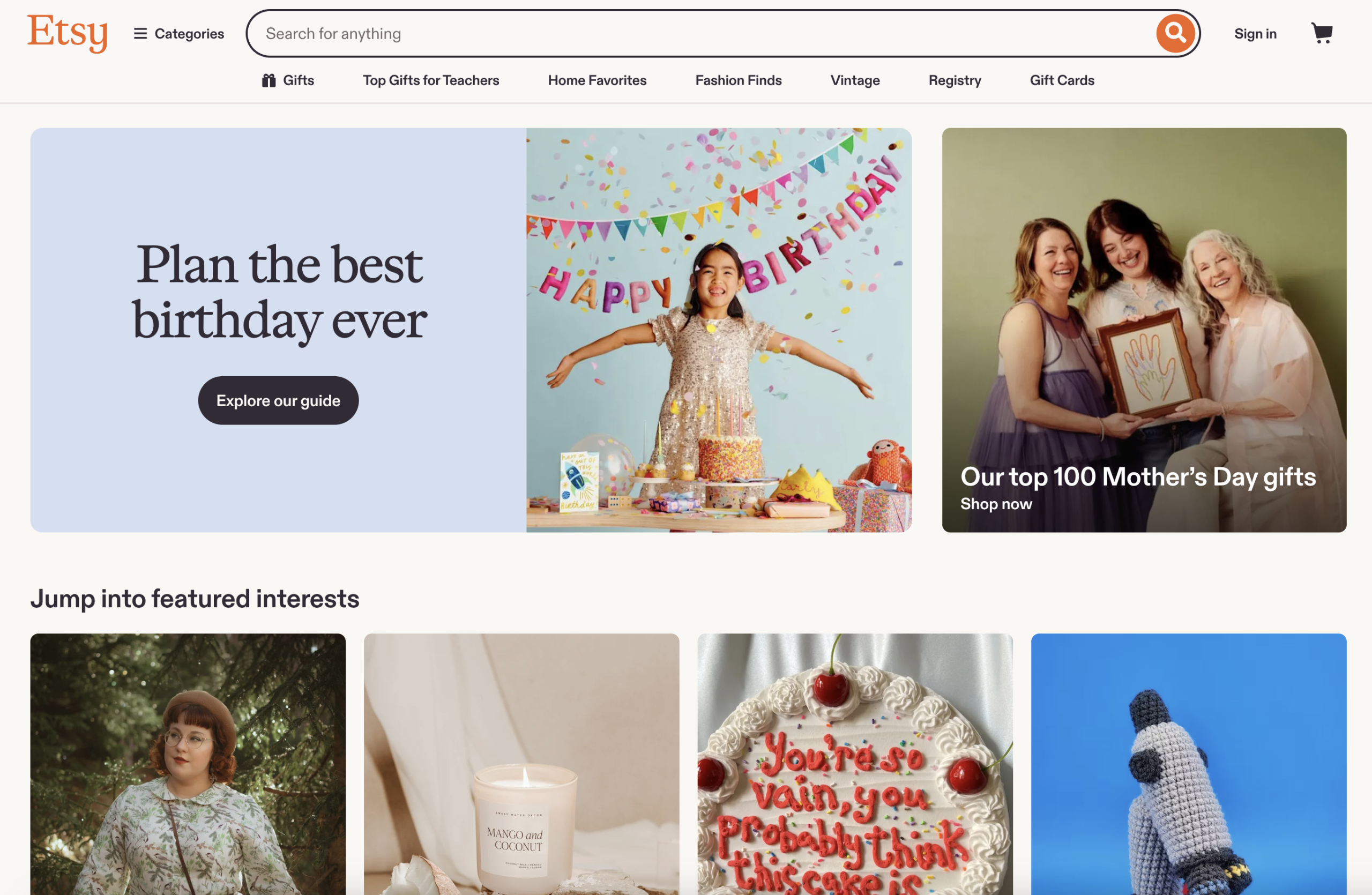
As of late 2025 and early 2026, Etsy has 86.6 million active Etsy buyers. While this is a decrease from 2024’s 95.94 million buyers, it’s still a large pool of potential buyers for the platform. Etsy also currently has 8.1 million active sellers, up from 2024’s 5.4-5.6 million active users. The platform is increasing the number of sellers but decreasing in terms of buyers. Overall, Etsy still has more buyers than sellers, so there is some potential to make money on this platform.
2. Ideal for aesthetic products
Etsy can be a great platform for those with beautiful-looking products. If your product looks visually attractive, it’ll be easier for you to attract sales on the platform. Products that look generic or don’t stand out might suffer from low sales volume. Considering you’re paying to list the products on the platform, more effort will be needed to create visually appealing products and hire a photographer who can create images people want to buy.
Etsy Cons
1. Intense competition
Many Etsy sellers are leaving the platform due to the intense competition from dropshippers. Dropshippers sell someone else’s products at a marked-up price, earning a profit on each sale. Since they aren’t selling their own product, it’s easy to find products for them to sell and list on the platform. Since most Etsy sellers create their own products, they are slower to produce, which makes each listing more important to them. They can’t compete on price or volume with the platform’s dropshippers.
2. Can’t build a brand
Etsy sellers can never stand out as their own brand on the platform. No one remembers the name of an Etsy seller, but everyone will always remember the Etsy brand over the individual seller’s. If you hope to expand into creating your own brand, with an email list and brand recognition, your best bet is to pick a platform like Payhip instead. Etsy will always be known as Etsy, no matter how many sales your Etsy store gets.
3. Rising costs
When comparing Etsy vs. Payhip, Etsy has much higher fees. The high platform fees make it harder to earn money from your products. Due to the competition, you’re expected to compete on price. However, competing on price means you’re eating into your already thin margins. With listing fees expiring each quarter, plus transaction and payment processing fees, there isn’t a lot of room to make money on the platform. You’ll need to do a lot of work to remove listings that don’t sell well and optimize listings that do, so you don’t get charged for products that don’t sell, as they cost money even if you don’t sell a single product.
4. Problematic policies
Since Etsy is a marketplace, customers who buy products can leave negative reviews. On top of that, other sellers can mark you as copyright infringement, even when you designed the product yourself. These two things, combined, can result in you being kicked off the platform without knowing why. All ecommerce platforms have terms of service you’ll need to follow. The problem with Etsy is that most sellers will mark you as copyright infringement even if you didn’t steal their copyright because they don’t want you as competition.
5. Invisible Shop
Without reviews and good SEO, you’ll likely find it difficult to attract customers to you when selling on Etsy. Competition aside, this marketplace still requires you to do some heavy lifting on the marketing side to be more visible on the platform. While Etsy does run ads on products, you’re not guaranteed sales from their marketplace unless you promote your own products.
FAQ
Payhip vs Etsy: Which is better based on niche?
Payhip and Etsy are targeted at different types of users. Payhip is the ultimate platform for creators in the digital products space. Payhip offers specialized features that let you sell online courses, digital products, memberships, and coaching. You can also sell physical products on the platform, though. Etsy is primarily a platform for handmade products. While you can sell digital products on the platform, it doesn’t have the functionality to sell online courses and related digital products.
Payhip and Etsy: Which pricing is better?
Payhip and Etsy have entirely different pricing models. Payhip offers a free forever plan with a 5% transaction fee. Payhip lets you add an unlimited number of products to your store with no additional listing fees. Etsy has a USD $0.20 listing fee per product you add. The listing fee expires every four months. Etsy also has a 6.5% transaction fee on the total sales price. Etsy also has a 3-4% + 0.25 payment processing fee. Overall, Payhip is the more budget-friendly option compared to Etsy.
Payhip vs Etsy: Which platform has better customer support?
Many sellers report positive interactions with Payhip support and negative interactions with Etsy support. The main reason is likely that when a seller needs to contact Etsy support, it’s usually because of a policy violation or suspension. Etsy will always side with customers over sellers. However, Payhip is more of a seller-centric brand, as you own your own customer marketing. Overall, Payhip has a large support team that responds quickly to inquiries and resolves concerns.
Payhip vs Etsy: Which is Better?
When comparing Payhip vs Etsy, Payhip comes out on top. The low fees, unlimited products, control over the brand, advanced product and marketing functionality, and instant payouts are among the many reasons Payhip is a better choice for sellers looking to sell their digital products online.


Payhip
Join over 130,000 creators who have launched their businesses selling digital products, online courses, memberships, coaching, and physical products.
Get started for free today
Comments
2 Comments
One important factor that doesn’t seem to be covered here is the “merchant of record” difference between platforms.
This has a big impact on who is legally responsible for the transaction, as well as who handles things like tax collection and compliance (GST/VAT).
For many sellers, especially those selling digital products internationally, this can be just as important as fees or payout speed.
It might be helpful to include a brief comparison of how this works across platforms, as it’s not something newer sellers are always aware of but can significantly affect their setup and obligations.
Hi Jarryd,
Thanks for bringing this up! It’s definitely something worth covering in more detail so I’ll pass this along to the team as a suggestion for a future update. 🙂
Leave a Comment