


12 Ecommerce Mistakes to Avoid Making in 2027
Building an online store can be a rewarding process, but it isn’t always intuitive for beginners. While building an online store, you might make completely avoidable mistakes. In this post, we’re going to share the most common ecommerce mistakes new store owners make to help prevent any issues from occurring for you.
12 Ecommerce Mistakes to Avoid Making in 2027
1. Using AI-generated photos for product images
With so many people using AI to create products, write copy, and make product photos, you might feel the competition racing in to outsell the competition. However, from what we’ve seen, many buyers still prefer human-made products, often more than AI-made ones. AI can whip up a product for you quickly, but you won’t own the copyright for it. Plus, when using AI for product images, one issue people run into is whether it’s false advertising. If your product doesn’t actually look exactly like the picture, people might report you for being a scam, false advertising, or even ask for a refund. This is the kind of ecommerce mistake that can lead you into legal issues. Overall, if you’re going to use AI for your online store, ask yourself if you’re deceiving anyone with the content you produce to ensure you aren’t liable if it doesn’t meet expectations.
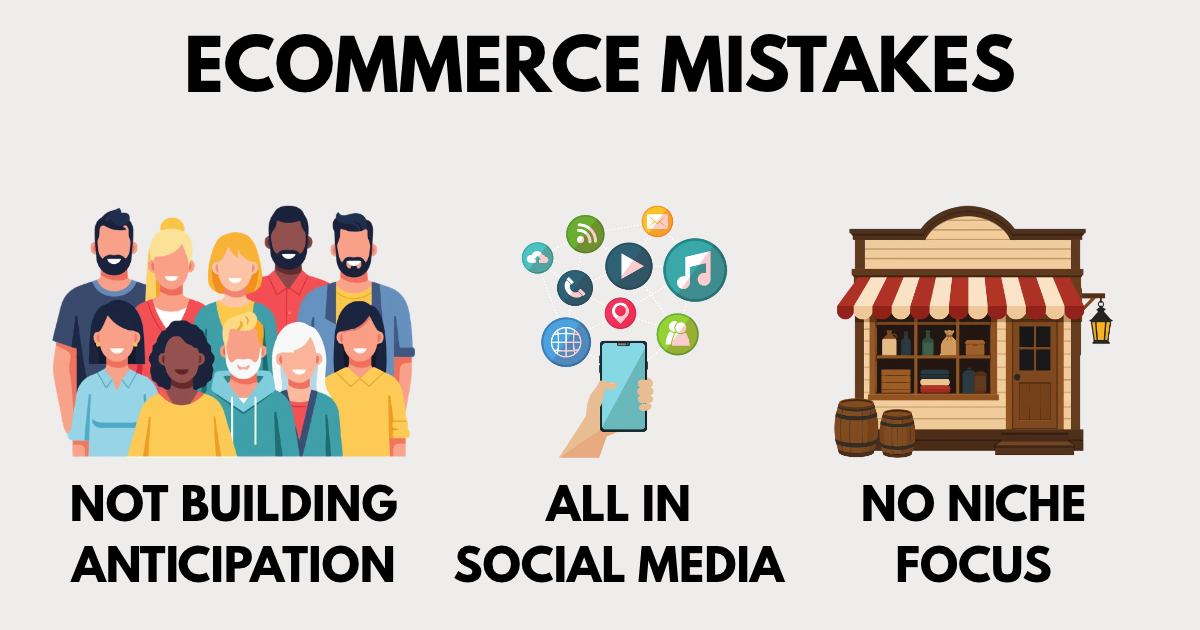
2. Failing to build anticipation before you launch
Most creators love creating products. It’s so fun to build something from scratch, whether it’s an ebook, course, digital download, or some other product. However, while you create your products, you need to
build an audience, particularly if you don’t have one yet. This is the biggest ecommerce mistake. If you launch your digital product without telling anyone or without an audience, you’re going to feel like a failure. But pre-marketing and audience building are among the most important steps to success in ecommerce. Your product could be the best on the market. If no one knows it exists, you’ll never make the money you deserve. What a bummer that is. Build an audience early and don’t stop for years. Your success will compound over time when you focus on building the exact audience you want to create products for.
Sell Digital Products with Payhip
No monthly fees. No tech headaches.
3. Exclusively running paid ads
When selling products online, one of the worst ecommerce mistakes you can make is relying exclusively on paid ads for monetization. The cost of ads has risen dramatically year over year, with each passing year becoming more expensive. There are actually a ton of free marketing ideas you can try. They don’t drive immediate sales if your website lacks domain authority. However, if you build your domain authority while running paid ad campaigns at the beginning of your entrepreneurial journey, you’ll find that you can eventually reduce your paid spend, allowing you to increase revenue more profitably through organic channels. If you focus exclusively on paid spend, with time you’ll find you aren’t as profitable as you could’ve been by diversifying your marketing efforts with organic marketing methods.
4. Not building out a content strategy
One of the best ways to succeed in ecommerce is to blend a content and commerce strategy. Those who don’t build out a content strategy end up hurting their potential sales growth, making it one of the killer ecommerce mistakes people make. Your online store should include landing pages, blog posts, and SEO-optimized product pages too. The secret to success is to focus your content on a single niche rather than multiple, so you can build your domain for a specific audience. The niche focus allows you to build an audience that enables search engines and LLMs to direct their traffic to your website. If Google can’t figure out what your website is about based on the content you produce, you won’t get qualified leads to your website, which can hurt your conversion rate and sales. If you’re using AI to create content, just know that even if you prompt it to be SEO-optimized, it still won’t be optimized the way that a trained SEO specialist would do it. You’ll have to make many tweaks or make multiple prompts to optimize your content correctly.
5. Focusing on too many social platforms
In the early stages of building an online store, many sellers overcommit to channels, eventually burning themselves out. Sticking to one social media platform might put all your eggs in one basket in the beginning. However, it allows you to learn how to grow an audience based on an algorithm. The findings you have can be replicated across other platforms. With time, you can eventually expand into other social media platforms. You’ll still want to get the social media handle for your business name before you launch your online store so no one takes it. However, choose platforms you can manage to create daily content on. If all you have is five minutes per day, you might choose to post on LinkedIn, Pinterest, X, Goodreads, Threads, or another platform that doesn’t require much effort to build an audience.
6. Building a general store from the beginning
One of the most important ecommerce lessons you can learn is the importance of having a niche focus. Many people are interested in many things. As a result, they create products that serve different audiences. A lot of people want to create a general store like Amazon because they think that’s how you make the most money. However, even Amazon didn’t start as a general store; it started as a bookstore. Originally, Amazon was a platform for buying books online; eventually, they expanded into toys, then they expanded into more and more categories. Today, they’re a general store because after maxing out their market, they dove into a new product category to get even more buyers. Don’t make the ecommerce mistake of going broad; always start as a niche seller.
7. Not tracking budget, spending, and profits
Running an online store isn’t just a fun hobby; it’s an actual business. As a business owner, you’ll need to track how much you spend, create a budget, and monitor your revenue and profit. Many sellers focus on how much revenue they generate. It’s actually really easy to get a high revenue number. However, profits matter more. If your business isn’t making money profitably, you’re likely in a ton of debt. Focusing on building a profitable online store means prioritizing marketing strategies that drive high sales volume at low cost. The cost-effective marketing strategies that do this include SEO, content marketing, email marketing, referral programs, and micro-influencer marketing. Your business needs a budget. You should track your spending each month and make it a habit to set aside time on the first day of the month to look at the previous month’s numbers to prevent making this ecommerce mistake. You should track all your spending, revenue, and profit by channel in a spreadsheet, with all the details you need clearly visible at a glance. You should also compare month-over-month and year-over-year growth or decline.
8. Not collecting customer email addresses
If a customer gives you their email address for an order, you don’t necessarily have authorization to send them email campaigns. With GDPR compliance and other email laws in effect, customers must opt in to receive email campaigns from your business. If they don’t opt in, you could receive a fine if an email is sent to them. Since email marketing is one of the most effective ways to increase your store’s sales when you release a new product, you’ll want to keep your email marketing efforts active as you grow your email list. Just remember to give customers the opportunity to opt in to receive marketing emails; include an email opt-in form in your website footer, in a pop-up, and in the checkout flow. The more places you can put an email form in, the more email subscribers your list can potentially have.
9. Making your product price too low
One strategy some sellers use to get more customers and sales is to underprice their products to edge out the competition. However, being the cheapest product on the market isn’t the ideal competitive advantage. If you look at how most tech businesses operate, most of their sales come from enterprise users with their most expensive plans. Focusing on a strategy to attract high-value customers will allow you to earn the revenue and profit you actually want. Don’t make the ecommerce mistake of underpricing your products. When selling digital products, you can bundle them to charge higher prices and increase the average order value. For example, if you’re selling coloring book pages, you can create mega bundles of 100 or more coloring book pages based on a theme. You can even bundle all your coloring book pages for multiple themes into an even bigger bundle. The amount you make from the bundle will allow you to continue selling online profitably, compared to selling individual pages.
10. Forgetting to test checkout before selling
Your first customer order should come from you; otherwise, you could make an expensive ecommerce mistake. Before you run a paid ad, run an influencer campaign, or promote your products on social media or to your email list, you should always run a paid test for the products you promote. Sometimes, people don’t realize that the product is not visible to customers; it’s only visible to them in the backend. Other times, you might find a mistake or typo in an email sent to customers. Overall, going through the process yourself or asking a friend to buy a specific product you plan to promote on your website will help prevent the mistake of wasting an email campaign on a dead link.
11. Neglecting customer support
One of the biggest ecommerce mistakes is neglecting customer support. With the rise in AI chatbots for customer support, more businesses are automating their support processes. However, there are times that customers aren’t getting the answers they need because there isn’t an option for their specific query. Being mindful of when customers aren’t satisfied with an AI response and actually need a human to resolve their issue is key for retaining customers and keeping them happy. Support debt can scale quickly. Support teams can also help increase sales by resolving issues, preventing refunds and chargebacks, and more. You can use AI to help automate parts of your customer support debt, but avoid using it to manage your entire support process, as it can still make mistakes.
12. Failing to differentiate yourself from competitors
One of the worst ecommerce mistakes you can make is failing to differentiate your brand in the market. Each business has a niche focus when compared to competitors. Some brands target different audiences. Others might have different brand values. Brands can also differentiate by voice, product quality, market inclusivity, or even patents. Overall, there are multiple ways to separate yourself from your competitors. You need to pick a differentiating factor that aligns with your business goals while staying true to what you stand for. For example, if you’re trying to position yourself as a premium product, you likely won’t be selling a completely AI product.
Conclusion
There are multiple ecommerce mistakes a seller can make on their online selling journey. Now that you’ve had a chance to reduce your error rate, it’s time to dive into the journey of creating and promoting your products so you can achieve the success that you deserve. If you’ve been thinking about building an online store selling digital or physical products, you can sign up for Payhip for free.


Payhip
Join over 130,000 creators who have launched their businesses selling digital products, online courses, memberships, coaching, and physical products.
Get started for free today
Comments
2 Comments
For #8, “Just remember to give customers the opportunity to opt in to receive marketing emails; include an email opt-in form in your website footer, in a pop-up, and in the checkout flow”, how does this work with email svcs that we’re connected to, like Kit? Does Kit automatically collect email addresses through my PH orders? Would I then go into a Kit list and delete or disable the email addresses that have not opted in through one of my email opt-in forms in my website? Thanks for your help.
Hi Sandi! Great question – so customers can opt in to marketing emails at checkout, and only those who opt in will be added to your mailing list in Kit. There’s no need to manually remove customers who haven’t opted in. 🙂
Leave a Comment