

Abandoned Cart Email Examples and Best Practices
Getting an abandoned cart can be soul-crushing for a store owner, especially if you’re new to selling online. However, abandoned carts are common in ecommerce. Fortunately, there are best practices you can follow to help you recover abandoned carts more effectively. In this post, we’ll even share some of the best abandoned cart email examples with specific use cases you can try for your own online store. Plus, you’ll learn a few of the common reasons why customers may choose to abandon their cart in the first place to help you overcome any potential challenges.
What is Cart Abandonment?
Cart abandonment occurs when a customer adds a product to their cart and begins checkout but does not complete it. When a customer abandons their cart, they’ve likely entered an email address or shipping information but haven’t completed the purchase.
Reasons Customers Abandon Their Shopping Cart
1. High shipping fees
One common reason people abandon their shopping carts is high shipping fees. In an ideal situation, you’d offer free shipping to customers. However, offering free shipping isn’t always profitable for all businesses. To compromise, some businesses offer a free shipping threshold, such as “Free shipping on orders over $150.” If you know you have high shipping fees, you could work with a vendor to reduce your rates to make shipping more affordable to customers. Alternatively, you can bake in your shipping fees into your product costs. For some people, it’s the sticker shock from taxes and shipping fees added after they’ve set a mental price that causes them to abandon the cart.
2. Long checkout process
A long checkout process can also be a reason why customers abandon their cart. On Payhip, guest checkout is enabled automatically, allowing people to check out even faster. However, if you’re on another platform, you might have to log in or use an authentication code to check out, which can slow down your checkout process. Overall, the faster your checkout process, the less likely customers are to abandon checkout.
3. Limited payment methods
Some customers abandon their carts because they don’t have their preferred payment methods. Some prefer paying by credit card while others might prefer Apple Pay. On Payhip, you have access to over 100 payment methods to offer your customers. All of the popular payment gateways offer a range of methods that make buying products online easier. Some ecommerce platforms limit the number of payment methods people can use. Payhip is an international brand with payment gateway options available across multiple countries and continents.
4. Customer price comparison
Another reason why shoppers abandon carts is that they do price comparisons across sites. Some customers may be actively looking for a specific product, checking multiple websites for the best deal. While price-competing can run your profits into the ground, you’ll want to offer fair pricing to boost sales and reduce cart abandonment.
Abandoned Cart Email Examples
1. The discount offer
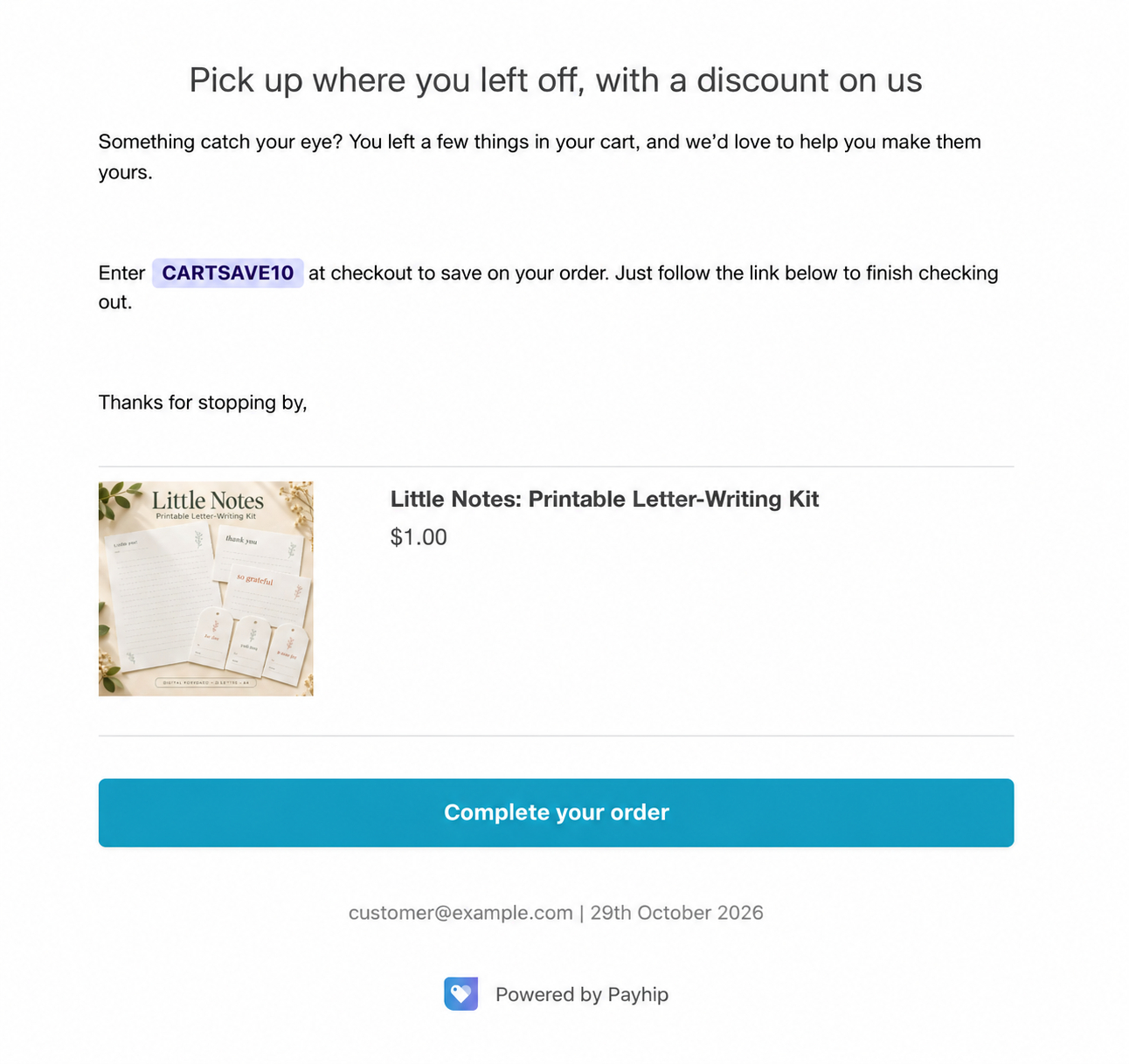
Some shoppers intentionally abandon their carts to receive an email discount and complete their purchase. Offering a discount is a common cart recovery tactic to help complete the sale. However, it shouldn’t be used for a first abandoned cart email. Often, store owners send two or three emails to help recover abandoned carts. The discount email is ideal for a final email. If you notice high cart abandonment rates for your store, you might choose to offer the discount in the first email.
2. Scarcity or urgency email
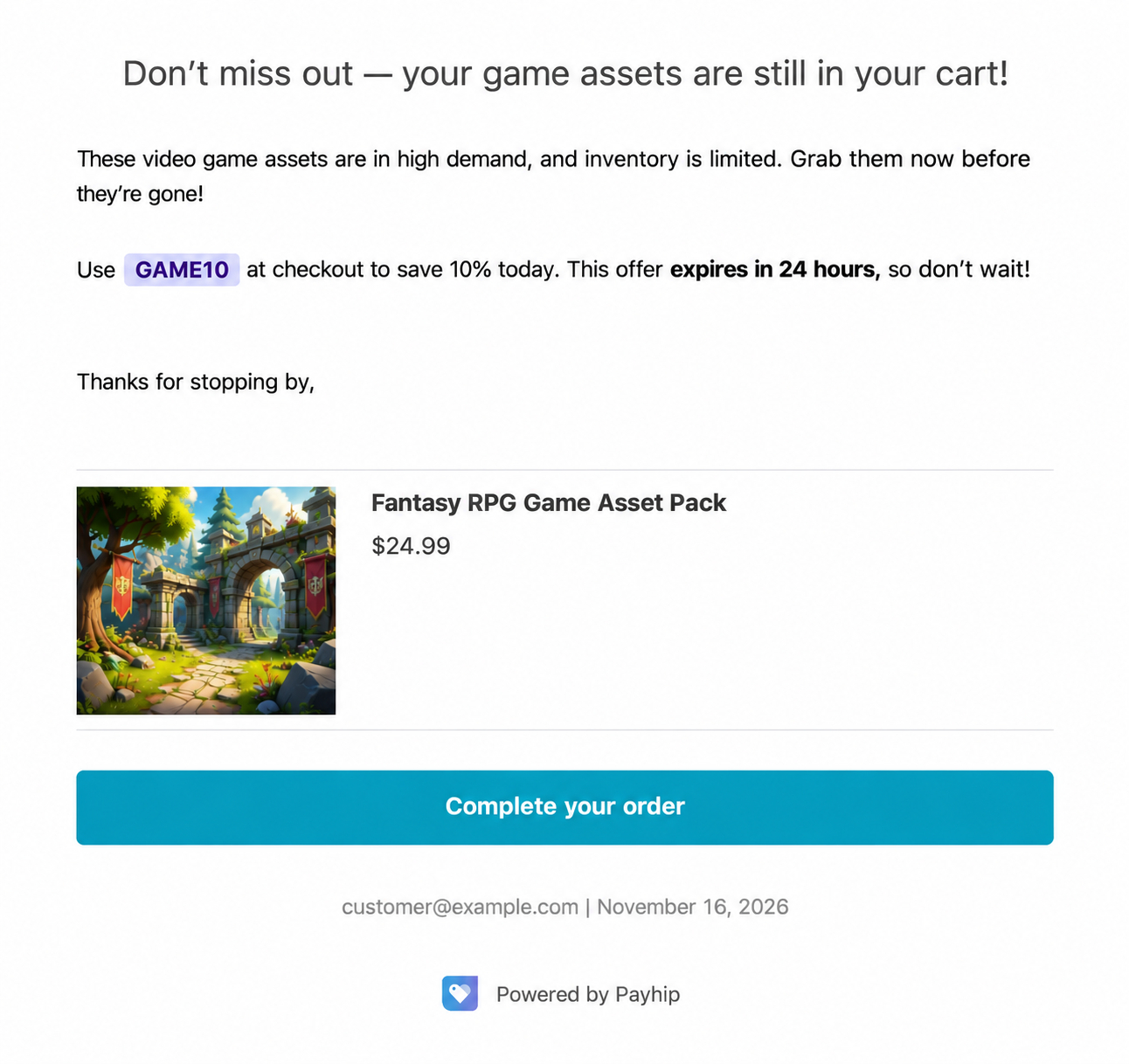
To better recover abandoned carts, approach your abandoned cart email through the lens of scarcity or urgency to attract more customers. Offering a discount with an expiration date creates urgency, prompting customers to buy now rather than wait. You can also highlight the remaining inventory when selling a physical item, so people don’t miss out on the product altogether if it sells fast. If you’re selling digital products, focusing on urgency is a better tactic for your email than scarcity, since you won’t have a supply issue.
3. Social proof email
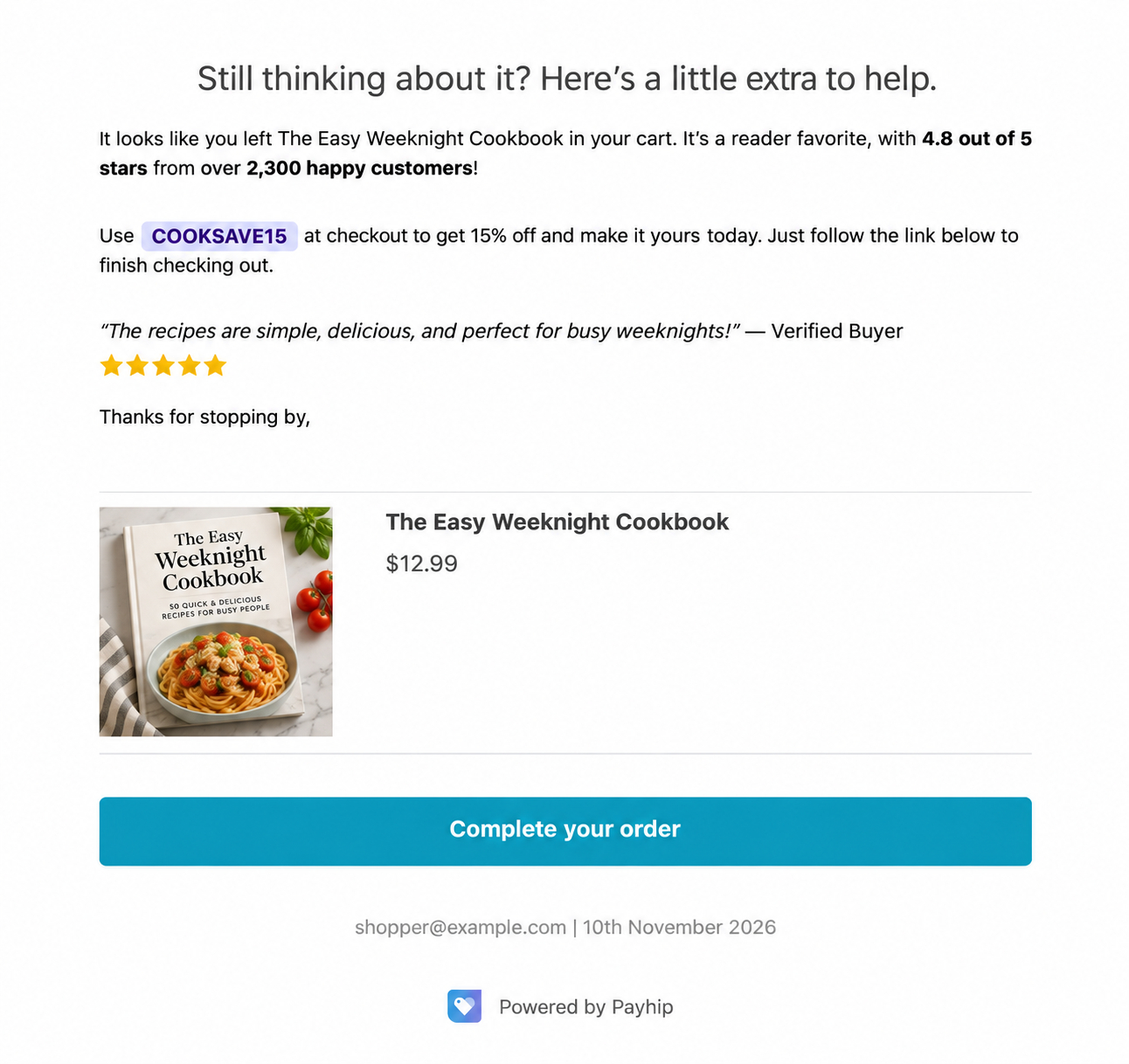
Another abandoned cart email example you can send is one focused on social proof. When sending abandoned cart emails, sharing your reviews or the number of happy customers helps you demonstrate your credibility. If someone is unsure whether your product is what they’re looking for, seeing signs of other customers or reading reviews will help them feel more confident about their purchase on your website.
Abandoned Cart Best Practices to Recover Sales
1. Send abandoned cart emails
One of the best abandoned cart best practices to help you recover sales is to send abandoned cart emails. You won’t recover every abandoned cart you get; however, you will recover some depending on the email strategy you use. If people don’t trust your website, you might choose to send an abandoned cart email based on reviews and social proof. If your final price is too high after taxes and shipping fees, you might offer a discount. Those who send abandoned cart emails will generate more overall sales than someone who doesn’t think it’s worth it. With Payhip, you can send abandoned cart emails at no additional cost.
2. Schedule emails at the right time
Every business uses a different strategy to recover abandoned carts. For example, one best practice is to send the abandoned cart email within 24 hours. However, many big brands send their abandoned cart emails within 2 hours to drive sales while it’s still top of mind for customers. Another best practice for
cart abandonment recovery is to send three emails. Each email should focus on a different strategy if the previous strategy failed. One email could offer a discount, another could focus on social proof, and a final email could feature last-chance messaging for a limited-time deal. Some brands send two emails with a small discount and a third email with the steepest discount they can offer profitably. There’s no set formula that works for everyone; whatever you try needs to work for your business specifically.
3. Write email subject lines with high open rates
No one knows which subject lines have high open rates until they start testing them. Most email providers allow A/B testing of an email subject line. For an A/B test, you would ideally create two subject lines to compare. If you split-test too many subject lines at once, it’ll take longer to get the data you need because you’ll need a larger sample. Once a statistically significant winner has been declared, you would compare that winner to other subject lines until you’ve created an email subject line that achieves a high open rate or reduces the abandoned cart rate. You could also split-test email copy to try different offers and determine which email is most profitable for your business.
4. Personalize your email copy
Another best practice for abandoned cart emails is to personalize your email. You can do this a couple of ways. For example, you can add a customer’s name to the email if they included it when they abandoned the cart. You can also include a link to the exact product they abandoned so people will recognize what product they wanted to buy. Personalizing emails is often more effective at recovering abandoned carts than not including specific details. If a customer still wants the product they abandoned but forgot to finish their order, they’ll click the link to continue their purchase.
5. Offer discounts to complete the purchase
Best practices for abandoned carts include offering discounts to encourage purchase completion. Some brands don’t mind offering discounts, as they still turn a profit from them and use them to drive more sales. However, some brands have tighter margins and will only send emails without any discount codes. Always run the numbers for your business to determine the best discount you can offer or whether you can offer one at all. Many shoppers are price-conscious, so some intentionally abandon carts to get a discount on their cart as a strategy.
6. Create a sense of urgency
Abandoned cart emails work best when there’s an element of urgency to them. With the passing of time, people will feel less pressure to purchase your product. The earlier you send the abandoned cart email with some copy that offers a limited-time deal, the more likely someone is to complete their purchase. Urgency is a common tactic used in ecommerce, with some stores adding countdown timers on their product pages to increase purchase speed. It’s important to not fake a sense of urgency with countdown timers that always reset or with limited-time offers that have no expiration date. Trust is an important part of selling online, so if you create a sense of urgency, ensure your offer actually expires.
7. Run retargeting ads
If you have a pixel set up on your website, you can run retargeting ad campaigns on those who’ve abandoned their cart. Your retargeting ads will show pictures of the product someone abandoned in their cart to remind them to complete their purchase. While sending an abandoned cart email on Payhip is free, running a retargeting ad requires a financial investment. Retargeting ads are typically cheaper than traditional ads, as people will recognize the website, so you’ll have a warmer lead. Retargeting ads can also target those who visited your site without buying anything, so in general, if you have a budget for paid ads, they can help you boost your sales more effectively.
Conclusion
Now that you know why people abandon their cart, have seen abandoned cart email examples, and know the best practices for abandoned cart recovery, it’s time to create your own abandoned cart email campaigns. Fortunately, all Payhip store owners can create abandoned cart emails at no added cost. If you haven’t built an online store yet, you can sign up for Payhip today for free.


Payhip
Join over 130,000 creators who have launched their businesses selling digital products, online courses, memberships, coaching, and physical products.
Get started for free today
Comments
Leave a Comment