


5 Sellfy Alternatives That Are Clearly Better Replacements
Sellfy isn’t the ideal ecommerce platform for those who want to build a business that actually makes money. The highest-tier plan caps at $200k per year, effectively blocking your earning potential. If you want to make money online without forced plan upgrades, there are better alternatives that are not only feature-packed on affordable plans, but some are even free. On Sellfy, you’re also capped on what you can sell. If you also want to sell courses, coaching services, or software, you won’t be able to do so on this platform. You can only sell digital downloads, subscriptions, and merch. If you’re looking for Sellfy alternatives that deliver great features, affordable pricing, and don’t force you into paid upgrades, this list will have you covered.
Why People Are Seeking Sellfy Alternatives
1. Forced Upgrades
Unlike most platforms, Sellfy has a sales cap per pricing tier. You can only make up to $10,000 in sales per year on the Starter plan. However, once you pass that number, you’re forced onto the next subscription tier without warning, which is now $30 more. This can lead to sticker shock as some people won’t remember why their pricing has suddenly changed. The sales caps are also so low, meaning you’ll likely pass these numbers with ease when running a business. Thus, pushing you into expensive plans with brute force. Overall, it’s unusual for an ecommerce platform to try to cap your revenue, giving sellers a good reason to find a Sellfy alternative.
2. Expensive Plans
Unlike most ecommerce platforms, Sellfy doesn’t have a free plan. Plus, their free trial only lasts about 14-days. That’s not a lot of time to build your site, play around with the tool to learn how it works, and get your first sale. Prices on Sellfy start at $22/month, whereas a platform like Payhip starts with a free plan. Their most expensive plan costs $119/month; however, once you pass $200k in sales, you’ll need to be on their enterprise plan, which doesn’t disclose the fees. The secrecy in plan pricing makes one assume that they’re much more expensive than the other three tiers.
3. Generic Storefronts
Sellfy sellers are limited by their theme choices. As a result, most stores end up looking the same. With a lack of flexibility in design, you won’t be able to stand out with ease. Differentiating yourself online is such an important part of brand awareness. If you use the same cookie-cutter themes as your competitors, your product won’t hit the targets you’re aiming for because you’ll be stuck in a sea of sameness.
4. Limited Marketing Tools
Sellfy lacks essential marketing tools for sellers. For instance, there’s no built-in blog CMS for you to create content on. Considering search traffic is the highest source of traffic for most online retailers, you’ll be missing out on a large volume of sales by not starting one. Plus, you won’t be able to edit on-page SEO metadata easily. Optimizing your site for search can’t be limited in any way if you plan on creating a successful business.
5. Not Ideal for Selling Physical Products
Sellfy isn’t set up to allow you to sell physical products easily. You’ll be limited by your inventory and product variants. You’ll only have access to basic shipping and logistics, such as real-time shipping rate calculations. Sellers will have to manually update sections rather than accessing bulk tools. There’s also no advanced analytics for selling high volume or internationally. Sellfy also doesn’t have the capacity to ship your products. This isn’t a good platform for dropshipping.
| Platform | Best For | Pricing | Key Pros | Key Cons | Best Overall Verdict |
|---|---|---|---|---|---|
| Payhip | Creators selling digital, physical products, courses, software, memberships | Free: 5% fee Plus: $29/mo (2%) Pro: $99/mo (0%) |
All features on all plans, no revenue caps, supports all product types, built-in marketing tools, VAT handled, marketplace access | No native email marketing (requires integration) | Best overall Sellfy alternative for affordability and scale |
| Gumroad | Creators selling digital products via marketplace | 10% + $0.50 fee +30% marketplace fee |
No upfront cost, built-in audience | Very high fees, limited SEO tools, no fee refunds | Best for marketplace exposure |
| Shopify | Large ecommerce stores (mainly physical products) | $29–$2,300+/month + fees | Highly scalable, large app ecosystem, strong infrastructure | Expensive, requires apps for digital products, limited built-in tools | Best for enterprise brands |
| Fourthwall | Print-on-demand and merch creators | Free + 5% fee Pro: $19/mo |
Merchant of Record, high-quality print-on-demand | Not ideal for digital products, no marketplace | Best for merch creators |
| WooCommerce | Advanced users wanting full control (WordPress) | Free plugin + hosting and other costs | Open-source, full ownership of data and store | Complex setup, high maintenance, hidden costs | Best for developers |
5 Sellfy Alternatives That Are Better Replacements
1. Payhip

Payhip is the best Sellfy alternative on the market. You’ll find more money in your pocket with plans suited for both beginners and high-volume sellers, so you can scale at your own pace without the hefty price tags.
While some Sellfy alternatives require third-party apps or plugins to add certain functionality, Payhip offers all features built in and on all plans. The blog CMS, discount codes, PDF stamping, license keys, upselling and cross-selling, affiliate program, and referral system are all features you can access, even on the free plan.
You can also sell a wider range of product types with this Sellfy alternative. For example, you can sell digital downloads, courses, software, memberships, coaching services, and physical products. All on one platform. No third-party tools needed.
As a store owner, you’ll be responsible for marketing your products. However, if marketing is hard for you, you can use a platform called Payhip Marketplace to sell your products to an existing audience with no additional fees.
PRICING
Payhip has three prices. While Sellfy gates features to force you to upgrade your plan, Payhip lets you access all features even on its free plan. Another reason Payhip is the best Sellfy alternative is that it lets you earn unlimited revenue across all plans. There’s no cap to your earning potential to force you into an upgrade, unlike Sellfy.
Free Forever
- $0/month
- 5% transaction fee
Plus
- $29month
- 2% transaction fee
Pro
- $99/month
- No transaction fee
PROS
- Ideal for beginners and sellers on a budget
- Built-in tools for courses, digital downloads, software, and more
- No feature gating, all plans have all features
- Offers EU/UK VAT handling
- Wide selection of product types you can sell from digital products, coaching services, and physical products
- Unlimited revenue, no revenue caps on any plan
- Fully customizable store builder
- Includes a blog CMS to build an audience on your site
- Marketing tools such as affiliate marketing, email marketing, referral system, and more
- 24/7 support team
- Over 100 payment gateways so you can sell internationally
- Has a marketplace where you can sell your digital and physical products
CONS
- No built-in email marketing; however, there are many popular integrations for you to choose from, giving you more choice in who you can select as an email provider
Sell Digital Products with Payhip
No monthly fees. No tech headaches.
2. Gumroad
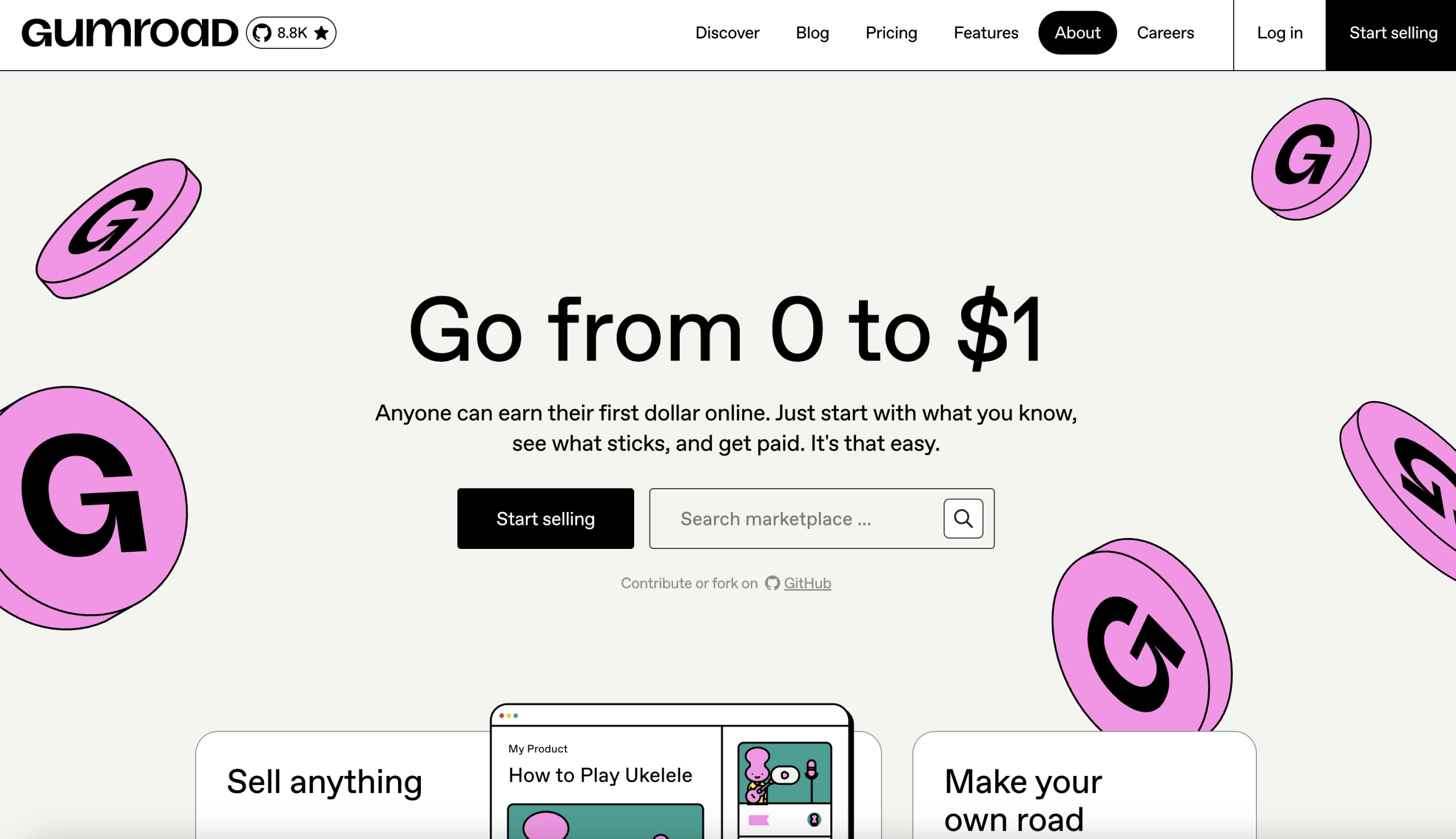
Gumroad is a Sellfy alternative with no upfront fees, as there’s no monthly subscription. However, that doesn’t mean it doesn’t come at a cost, a pricey one at that.
Gumroad offers limited payment gateway options, with sellers able to choose only Stripe and PayPal. However, even PayPal requires at least $100 in sales before you can add it as an option for your buyers. Overall, with most ecommerce providers offering 100 payment gateways so people can sell globally, Gumroad falls short in this respect.
Gumroad doesn’t have any built-in SEO tools. However, if you want to make sales on their marketplace, you can sell there, provided your product doesn’t incur many chargebacks. You’ll have to fork over 30% of the sale price if you get a sale from the marketplace. However, you won’t get your 30% refunded if your buyer refunds the purchase, as Gumroad states it doesn’t refund any fees.
PRICING
Unlike Sellfy, Gumroad doesn’t have any monthly subscriptions. However, they charge higher transaction fees than any other competitor on this list, making it an expensive option, particularly for high-volume sellers.
Gumroad Pricing
- 10% + $0.50 per transaction
- 30% per transaction via the marketplace
- 3% transaction fee for instant payouts
PROS
- No upfront fees
- Has a built-in audience via the marketplace
CONS
- Expensive option compared to Sellfy
- Doesn’t have an upselling feature
- Lacks built-in tools for SEO
- Need to have earned at least $100 to add PayPal as a payment option
- Limited options in payment gateways
- High fees for marketplace listings
- Various rules against selling physical products, such as dropshipping
- Doesn’t refund platform fees if buyers refund the order
3. Shopify

Shopify is likely the most expensive platform on this list. Part of the reason is that there are few built-in
features, so most sellers have to add third-party apps to get the functionality they need. To sell digital products on Shopify using apps like Sellfy, you need to install an app, which comes with its own fees and subscriptions. These apps can all add up to create a one-of-a-kind but highly expensive business to run.
While Sellfy offers features that allow people to sell digital products easily, Shopify doesn’t offer this natively. For instance, you’ll need a third-party app to add PDF stamping to your digital downloads. Whereas platforms that natively allow digital products to be sold on the platform offer this feature automatically.
PRICING
Shopify charges subscription fees like Sellfy. They also don’t put caps on your earning potential. You won’t be forced into an upgrade based on revenue volume. However, Shopify subscription plans are more expensive than Sellfy’s.
Basic
- $29/month
- 2.9% + $0.30 card processing fee
Grow
- $79/month
- 2.7% + $0.30 card processing fee
Advanced
- $299/month
- 2.5% + $0.30 card processing fee
Plus
- From $2,300/month
- 2.25% + $0.30 card processing fee
PROS
- 16,000 apps in their app store
- 800 themes to choose from
- Over 100 payment gateways
CONS
- Expensive platform for beginners, with no free plan
- Very few built-in features; most require a third-party app to install
- Limited product variants: size, color, and material only
- Layoffs in the support team have slowed response times
- Steep learning curve for the platform
- Requires apps to sell digital products
- Lacks built-in tools such as PDF stamping or file protection
- Transaction fees on top of the subscription
4. Fourthwall
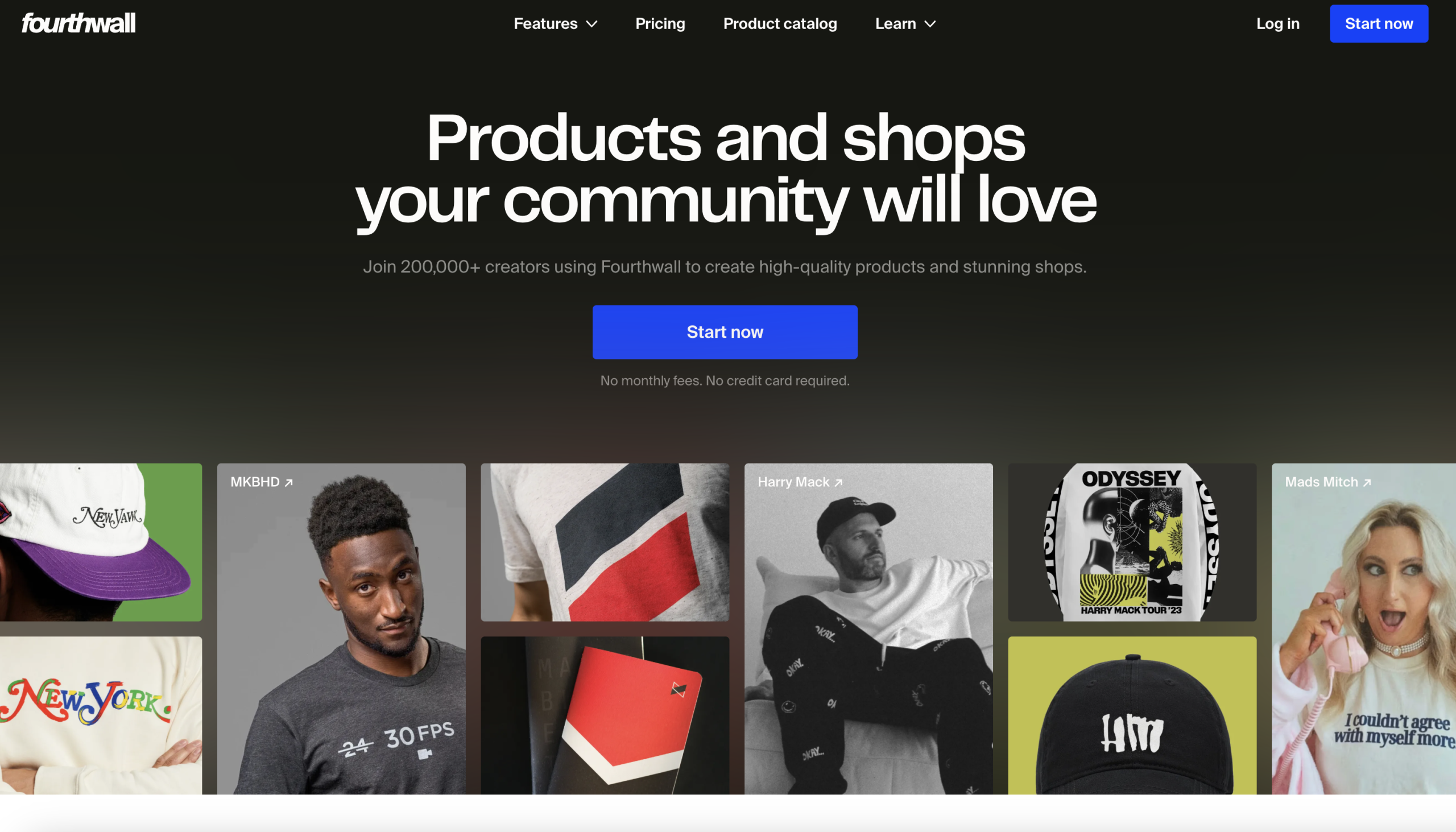
Fourthwall is an ecommerce platform that allows you to sell print-on-demand products. This Merchant of Record isn’t known for selling digital products, which might make Sellfy a less favorable alternative depending on what you plan to sell.
Despite being an ecommerce platform, Fourthwall lacks a marketplace where you can sell the products you create. Most store builders have a marketplace where you can reach a pre-existing audience to drive more sales.
PRICING
Fourthwall’s monthly subscriptions are lower than Sellfy’s, making it an interesting Selly alternative. However, some products you sell require an additional fee, such as digital products and memberships.
Free
$0/month
5% fee for selling digital products
5% fee for selling memberships
2.9% + $0.30 credit card transaction fee
Pro
$19/month
5% fee for selling memberships
2.9% + $0.30 credit card transaction fee
PROS
- Acts as a Merchant of Record
- Higher quality of print-on-demand products than Sellfy
CONS
- Less suitable for selling digital downloads
- Limited design quality
- Basic product pages
- Harder to set up
- Not ideal for large collections of products
- Dependent on their logistics network
- No built-in marketplace for easy discovery
- Doesn’t support all print techniques, such as laser engraving
5. WooCommerce
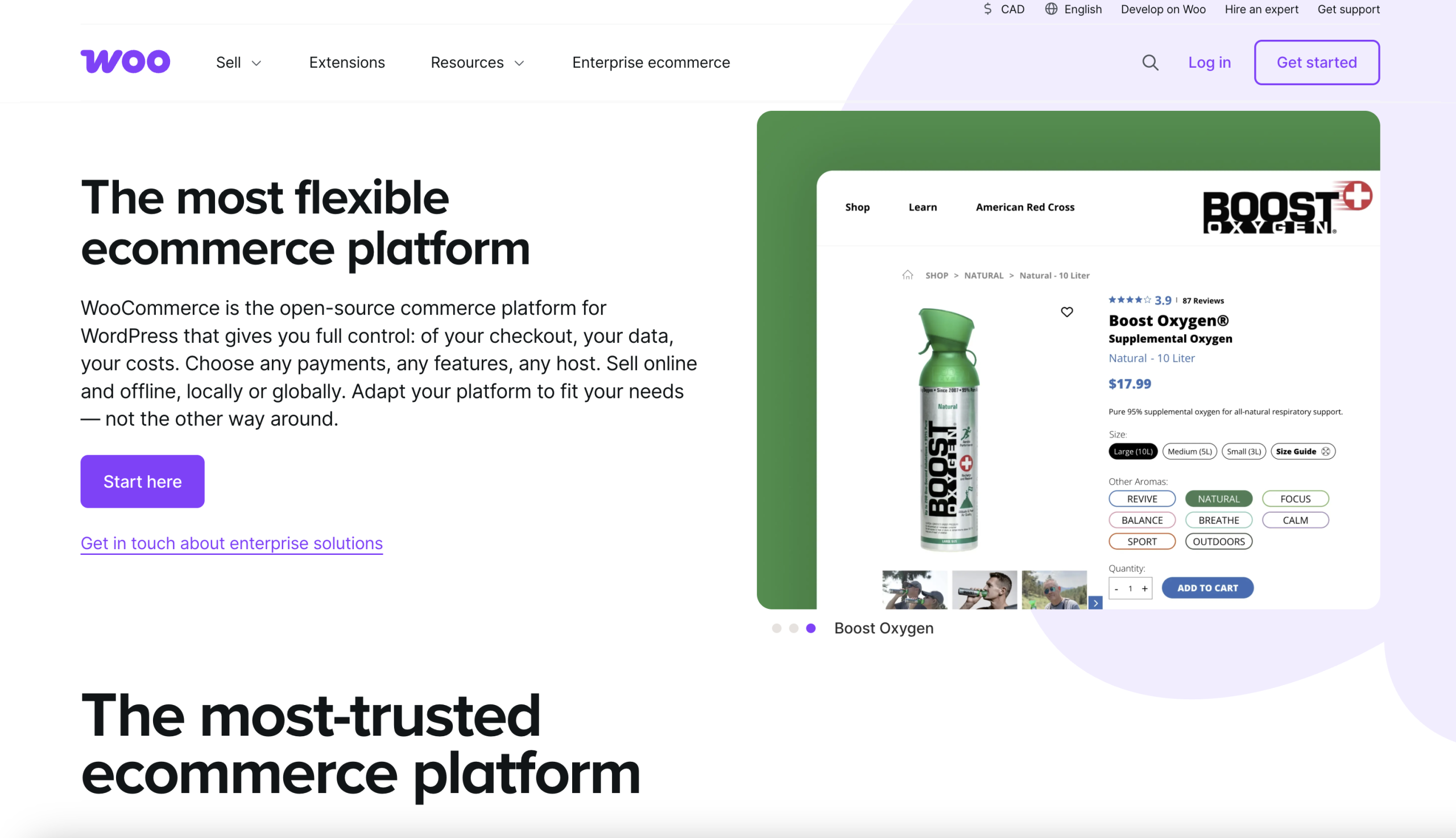
WooCommerce is a WordPress plugin that lets you build an open-source website. As an open source platform, you’ll own your customer data and the website you build. While that sounds good in theory, the reality is that building an online store this way costs a lot of money, requires a ton of maintenance, and you end up needing to hire someone to fix minor issues that a company would’ve resolved quickly.
WordPress is a plug-in-heavy platform. Depending on what other plug-ins you install aside from WooCommerce, you might find your site starts to lag, or your website breaks as your website updates, but plugins don’t. Overall, it can be complicated to integrate multiple components into your website.
PRICING
WooCommerce is a free alternative to Sellfy. However, unlike other Sellfy alternatives on this list, you’ll have to pay for a few things out of pocket. For instance, hosting, domain registration, themes, design and development costs, carrier fees, payment gateways, inventory management, accounting tools, security, compliance and data privacy, and more are just some of the key expenses you’ll need to pay for that won’t be covered by signing up to WooCommerce.
WooCommerce Pricing
- Free
PROS
- Open-source allows ownership of your data and platform
- Integrates with WordPress seamlessly
CONS
- Complex setup requiring putting third-party tools together
- Self-managed maintenance and hosting, lots of independent upkeep
- Hidden fees with all the third-party tools needed
- Minimal support
- Seller is responsible for site security
- No built-in marketing tools
- Frequent bugs or site crashes
- Not necessarily mobile responsive
- Developers are frequently needed to debug
FAQ
What are the best alternatives to Sellfy?
The best alternatives to Sellfy are Payhip, Gumroad, and Shopify. These platforms are feature-rich, allowing you to sell as a beginner or an established business.
What is the cheapest Sellfy alternative?
The cheapest Sellfy alternative is Payhip, which has a free plan. The free plan charges a 5% transaction fee on each sale, with no payment due if you haven’t made one.
Which platform is better than Sellfy for selling digital products?
Payhip is better than Sellfy for selling digital products. Each digital product you can sell on the platform offers specialized features, such as drip content, quizzes, surveys, assignments, completion certificates, and more for selling online courses. If you plan to sell ebooks or digital downloads, you can do PDF stamping to prevent piracy. If you want to sell software, you can generate license codes.
Are there free alternatives to Sellfy?
Yes, Payhip is a free alternative to Sellfy with no paid subscription. You only pay a 5% transaction fee once you make a sale. However, there are no upfront fees on the free plan. If it takes you a longer time to get a sale, you won’t have any additional fees to pay.
Which platforms offer better SEO than Sellfy?
Payhip offers better SEO than Sellfy as it allows you to access a built-in blog CMS for you to create content on your own website, so you can rank organically in search and LLMs. You’ll be able to create as many web pages as you need with no additional fees or caps, allowing you to build an audience on the platform to drive traffic back to your website.


Payhip
Join over 130,000 creators who have launched their businesses selling digital products, online courses, memberships, coaching, and physical products.
Get started for free today
Comments
Leave a Comment