Your Cart
Loading

WHERE WOULD YOU LIKE TO PRACTICE?

Looking for examination preparation rather than country registration information? → Visit Board & Registration Review.


Explore chiropractic registration requirements, regulatory contacts, examination pathways and practical information for working internationally.

COUNTRY INFORMATION GUIDE

CANADA

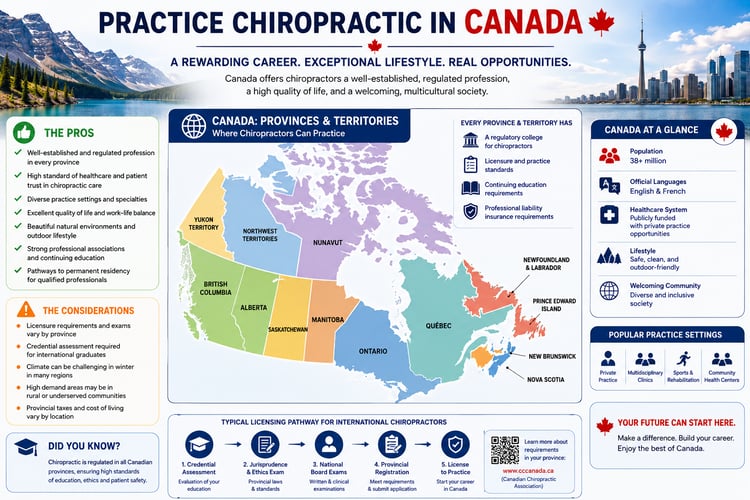
Canada can be an attractive destination for chiropractors seeking an established profession, high clinical standards, diverse communities, and an excellent quality of life. Chiropractic is regulated provincially, and chiropractors practice throughout the country in private clinics, multidisciplinary settings, sports and rehabilitation environments, and community-based practices. For an internationally trained chiropractor, Canada can offer both a professional career and the opportunity to build a long-term life in one of the world's most geographically diverse countries.

Advantages: a well-established and regulated chiropractic profession; strong professional and educational infrastructure; high standards of healthcare; English-speaking opportunities across most provinces and French-speaking opportunities particularly in Québec; multicultural communities; spectacular outdoor recreation; and potential opportunities in smaller cities and underserved communities.

Considerations: registration is province-specific, so credential assessment, examinations and other licensing requirements must be investigated carefully; international graduates may face a substantial registration process; housing and general living costs can be high in cities such as Toronto and Vancouver; taxation can be comparatively high; and Canada's winters, distances between cities, and regional differences in lifestyle can require some adjustment.

UNITED KINGDOM

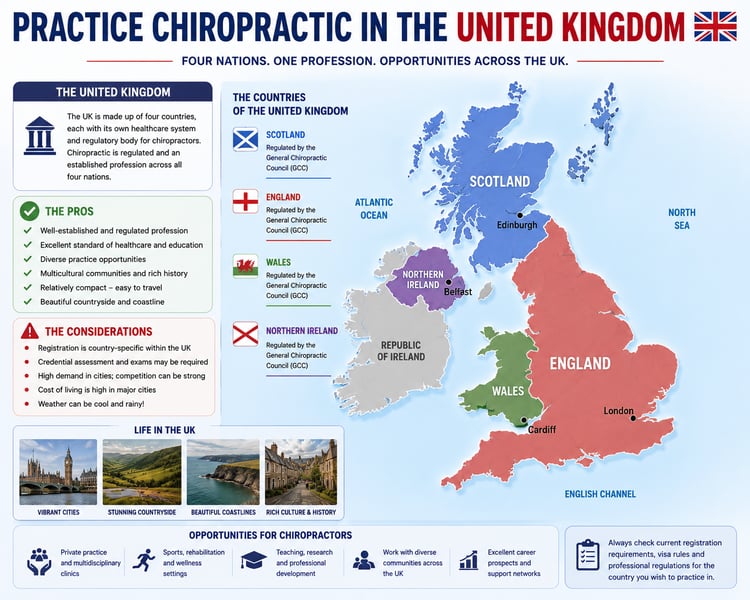
The United Kingdom offers chiropractors the opportunity to practice within a well-established and nationally regulated profession while enjoying one of the world's richest combinations of history, culture, countryside and modern city life. Chiropractors can build careers throughout England, Scotland, Wales and Northern Ireland, from major metropolitan practices to smaller community and multidisciplinary clinics.

Advantages: an established profession regulated by the General Chiropractic Council (GCC); English-speaking professional environment; strong chiropractic and healthcare communities; opportunities in private practice, multidisciplinary clinics, sports and rehabilitation; excellent transportation links; and easy access to Europe for travel. The UK also offers remarkable variety—from London and other major cities to historic towns, coastal communities, Scotland's Highlands and the Welsh countryside.

Considerations: overseas-trained chiropractors must satisfy GCC registration requirements before using the protected title chiropractor in the UK; qualification recognition and competency requirements should be investigated before relocating. Housing and living costs can be high, particularly in London and parts of southern England; taxation and operating costs need consideration; competition may be greater in areas with many established practices; and the weather can take some adjustment.

Why consider the UK? For chiropractors wanting an international career without a major language barrier, the UK provides an appealing combination of professional structure, cultural experience, travel opportunities and lifestyle choices—all within a relatively compact country.

EUROPE

Europe offers chiropractors an extraordinary range of professional and lifestyle choices. From the established chiropractic communities of Denmark, Norway, Sweden, Switzerland and Ireland to opportunities across France, Germany, Spain, Portugal, Italy, the Netherlands, Belgium, Finland and other European nations, each country provides a different combination of healthcare systems, regulation, culture and potential patient markets.

Advantages: Europe can provide an exceptional quality of life, extensive public transportation, rich cultural experiences and the ability to travel easily between countries. Depending on the jurisdiction, chiropractors may find established professional networks, multidisciplinary healthcare environments, sports and wellness opportunities, or developing markets where chiropractic services are less widely available. For the adventurous practitioner, learning another language and becoming part of a local community can make practicing abroad especially rewarding.

Considerations: Europe should never be viewed as a single regulatory environment. The legal recognition of chiropractic, protected titles, permitted scope of practice, educational requirements and registration procedures can differ substantially from one country to another. Language proficiency may be essential for clinical practice, and immigration or work authorization, taxation, professional insurance and business requirements must also be considered. Salaries, practice expenses and cost of living can vary dramatically between countries—and even between cities within the same country.

Why consider Europe? A chiropractor might choose Scandinavia for its established healthcare systems and quality of life; Switzerland for its highly structured professional environment; Spain, Portugal or Italy for climate and lifestyle; France, Germany or the Benelux countries for access to major population centers; or another developing European market for the challenge of helping expand awareness of chiropractic care.

For chiropractors willing to research carefully and adapt to another healthcare culture, Europe can offer something considerably larger than a job: an international professional experience, a different way of life and the opportunity to become part of chiropractic's continuing development around the world.

AUSTRALASIA

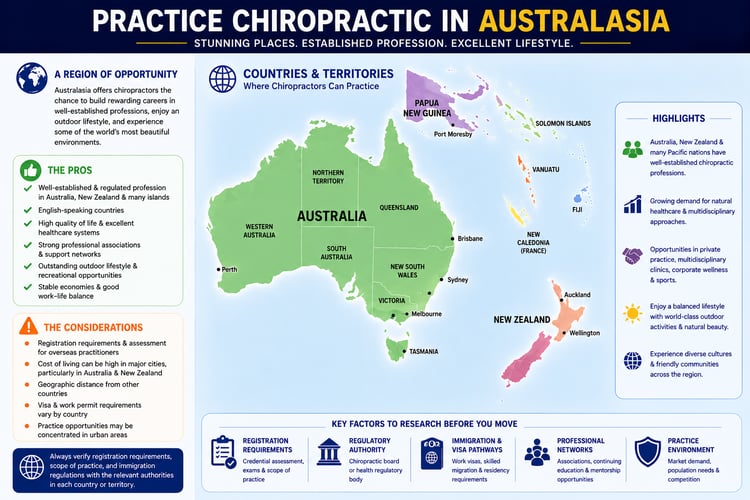
Australia is particularly attractive to chiropractors seeking a well-established, regulated profession combined with an outdoor-oriented lifestyle. Chiropractic is integrated into the country's private healthcare landscape, but overseas practitioners must satisfy formal registration requirements.

Advantages: established regulated profession; English-speaking environment; strong professional infrastructure; excellent recreational opportunities and generally high living standards.

Considerations: overseas qualification assessment and registration requirements; potentially lengthy relocation process; high housing and living costs in major cities; geographic distance from North America and Europe.

ASIA

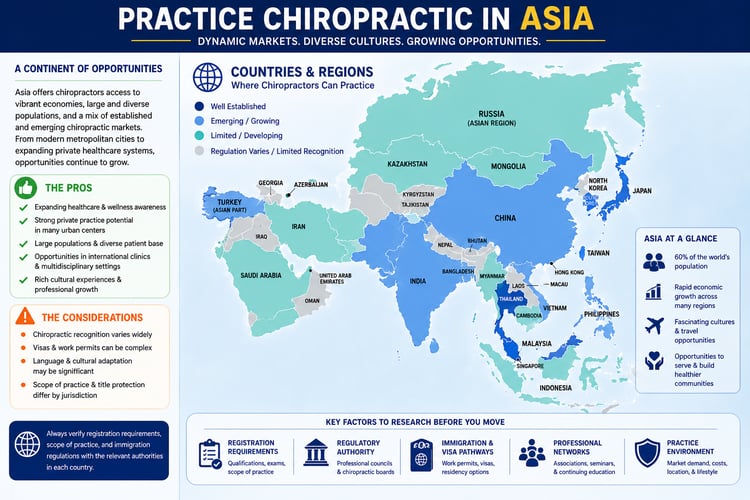
Asia offers chiropractors exposure to enormous and increasingly internationally connected healthcare markets. Major cities can provide sophisticated private healthcare environments and opportunities to work with expatriate and local populations.

Advantages: potentially strong private-practice opportunities; large population centers; fascinating cultural experience; opportunities in international and multidisciplinary clinics.

Considerations: chiropractic recognition varies widely; visas and work permits can be complex; language and cultural adaptation may be significant; professional scope and title protection differ between jurisdictions.

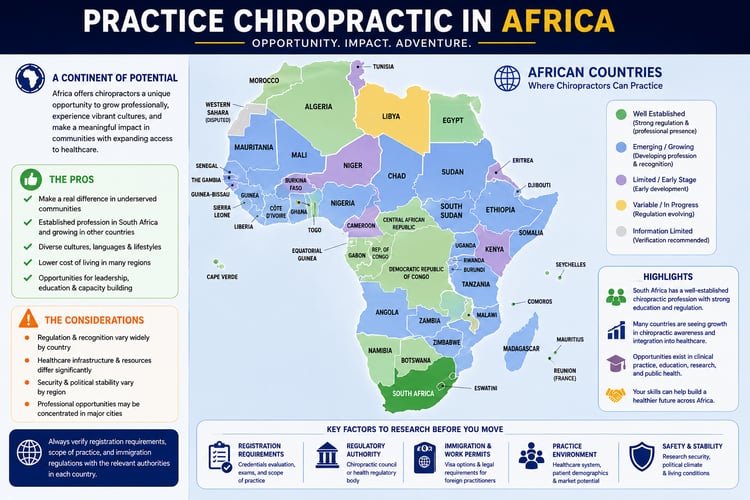
AFRICA

For chiropractors interested in combining professional practice with adventure and service, parts of Africa offer distinctive opportunities. South Africa has a particularly established chiropractic profession, while elsewhere access to chiropractic care may be limited.

Advantages: potential to serve communities with limited access to chiropractic care; distinctive lifestyle and cultural experiences; established education and professional structures in South Africa; opportunities for professional leadership.

Considerations: regulation and professional recognition vary considerably; healthcare infrastructure differs by region; security and political conditions require country-specific assessment; professional opportunities may be geographically concentrated.

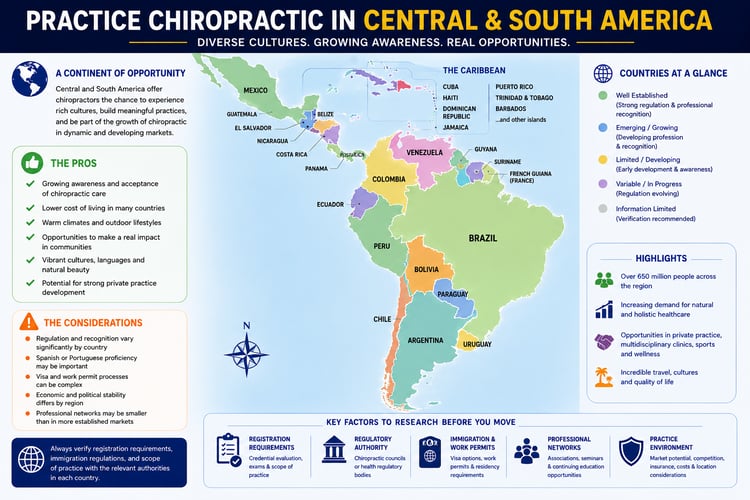
CENTRAL AND SOUTH AMERICA

South America can appeal to chiropractors looking for cultural immersion and opportunities in developing chiropractic markets. Major metropolitan areas may provide private-practice opportunities, while professional recognition varies significantly between countries.

Advantages: rich cultural experience; potentially lower living costs in some countries; developing chiropractic awareness; opportunities to build practices within underserved markets.

Considerations: Spanish or Portuguese proficiency may be important; regulatory status differs considerably; economic and political conditions vary; professional networks may be smaller than in established chiropractic markets.

Thinking about practicing abroad? The opportunity involves much more than choosing a destination. Explore each country’s registration requirements, credential recognition, regulatory authority, examinations, immigration considerations, professional organizations, and practice environment before making the move.