
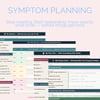


The Symptom Management Planner: Chronic Illness Planning & Flare Management Spreadsheet
Chronic Illness Planning & Flare Management Spreadsheet
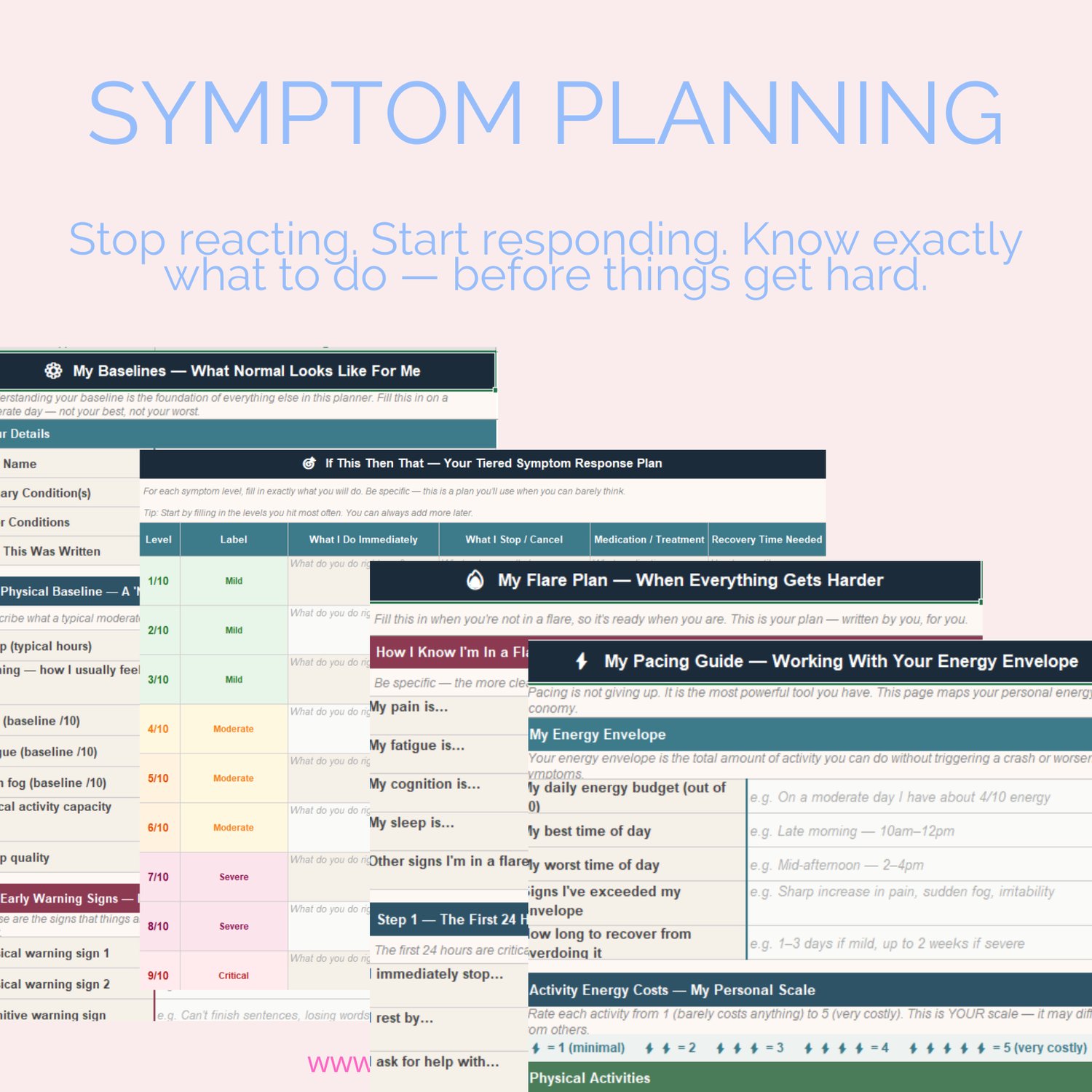
Stop reacting. Start responding. Know exactly what to do — before things get hard.
When you're in a flare, you can't think.
That's not a character flaw. That's physiology.
Pain, fatigue, and brain fog don't just make things harder — they make decision-making almost impossible. The moment you need a plan the most is the moment you're least able to create one.
So you push through when you should rest. You cancel everything when you could manage some of it. You forget what helps. You can't find the words to ask for what you need. You wait until you're in crisis to figure out what a crisis even looks like for you.
The Symptom Management Planner is the plan you build when you're calm — so it's ready when you're not.
What it is
A deeply personal planning spreadsheet that helps you understand your body, prepare for bad days, and respond to symptoms with clarity instead of panic.
Nine tabs. Written by you, for you, in advance. Covering everything from your first warning signs all the way through to the words you need when yours run out.
This is not a tracker. It doesn't ask you to log data every day. It asks you to think carefully, once — about what your body does, what you need, and how you'll respond — and then it holds that knowledge for you, ready to access any time.
What makes it different — five features worth knowing about
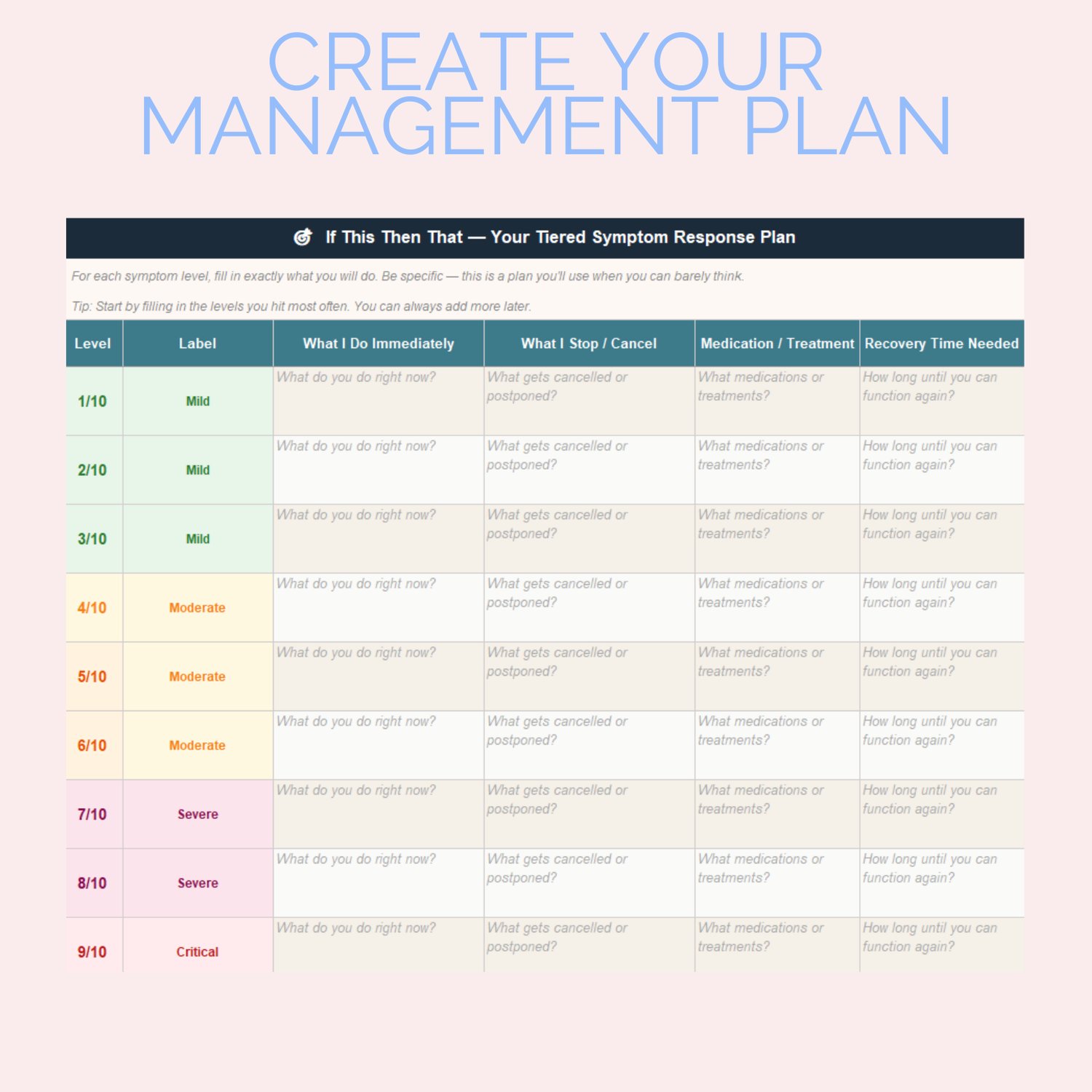
If This Then That — Your Tiered Response Plan
The most immediately useful tab in the planner.
For each severity level from 1 to 10, you define exactly what you do. Not vaguely — specifically. At a pain level of 4, I cancel this and keep that. At level 7, I take this medication, I contact this person, I rest for this long.
There are two full symptom scales — one for your primary symptom (pain, fatigue, whatever affects you most), and a second, fully customisable scale for your next most disruptive symptom.
The colour coding runs automatically from green (mild) through amber to red (severe). When you're struggling, you look at a number, find the row, and follow the plan you made when you were well enough to think clearly.
You don't have to figure out what to do when you're at a 7. You already decided.
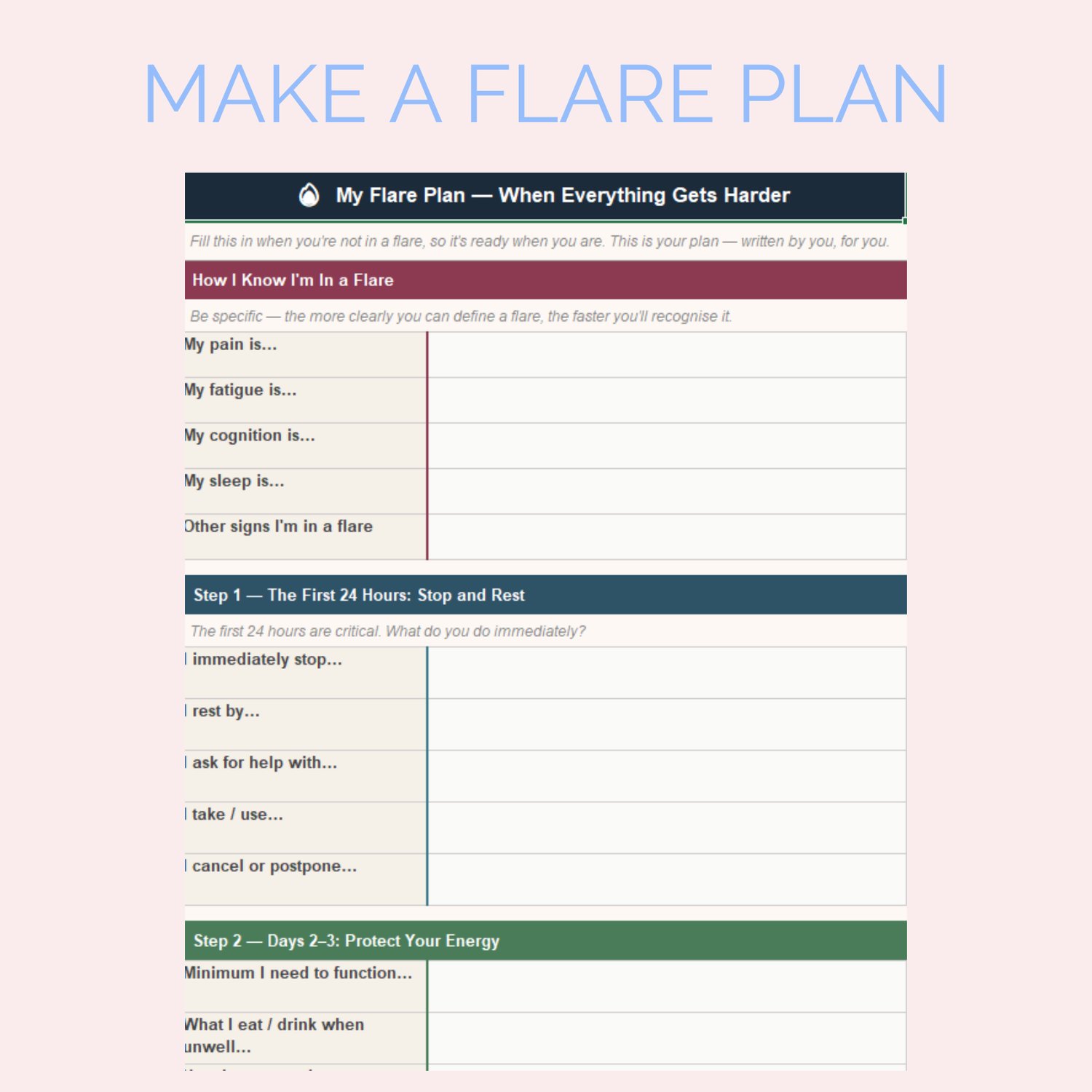
Flare Plan — Your Step-by-Step Guide for the Hard Days
A flare plan is one of the most recommended tools in chronic illness management — and one of the least often actually made.
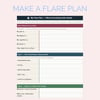
This tab walks you through three stages: the first 24 hours (stop and rest), days two and three (protect your energy), and the return phase (coming back slowly, without triggering another flare).
It includes a "What NOT to Do" section — because when you're in a flare, you will convince yourself you can do more than you can. Having a list you wrote when you were calm is harder to argue with than a feeling.
And it includes a medical escalation section: when to call your GP, when to go to urgent care, when to seek emergency help. These are decisions you should not be making at your worst — make them now.
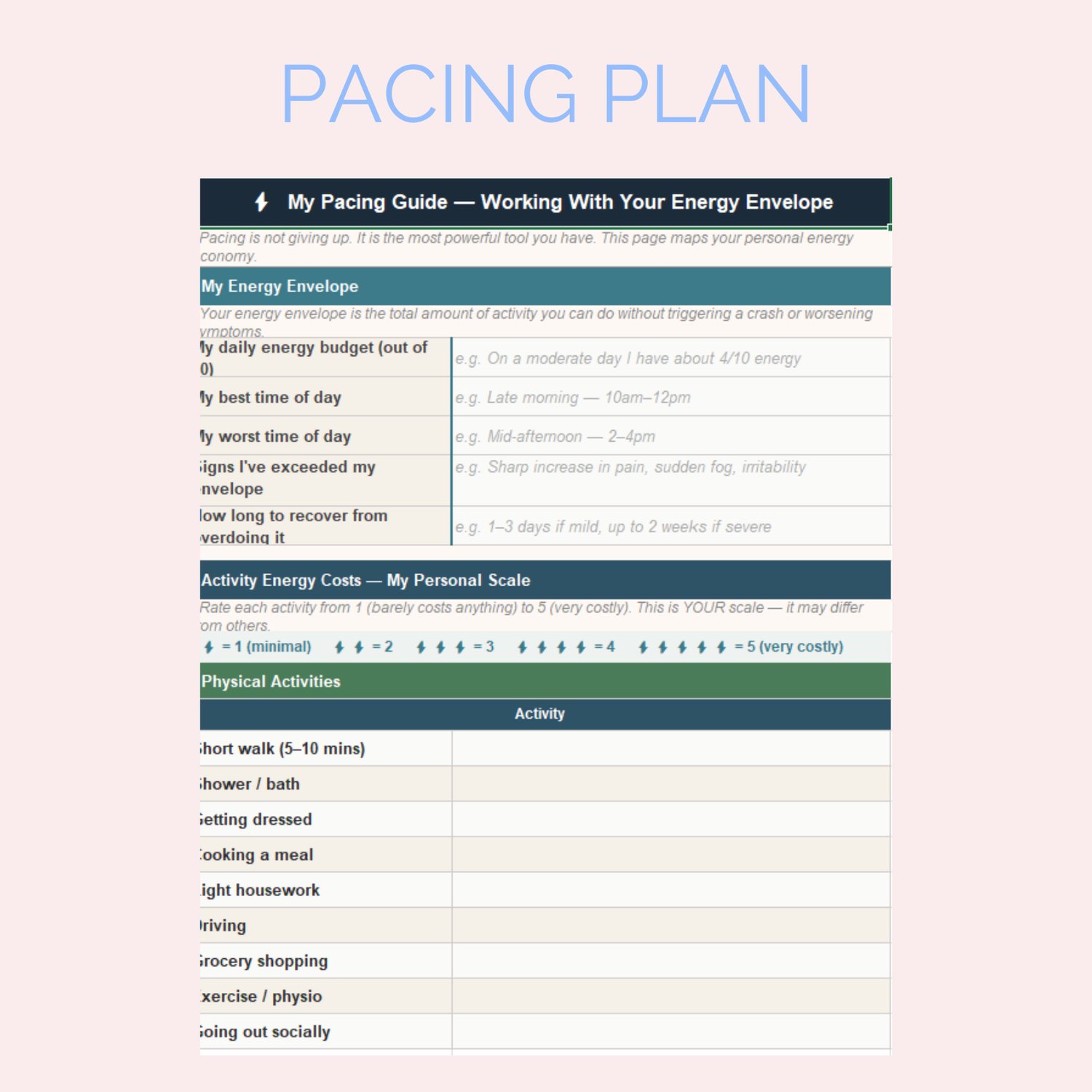
Pacing Guide — Your Personal Energy Economy
Not a generic pacing guide. Yours.
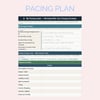
You define your energy envelope — how much you have, when it's highest, when it crashes. You build an activity cost table: how much does a shower cost you? A phone call? A medical appointment? Driving?
Most people are surprised by what they find when they map this honestly. Activities they think of as "low effort" turn out to be expensive. Rest that feels like "doing nothing" turns out to be essential spending.
Once your personal energy economy is mapped, you can budget. You can make real choices about where your energy goes — rather than spending it unconsciously and wondering why you crashed.
Gentle Routines — Structure for Every Kind of Day
Three tiers. Bad day, medium day, better day.
Each one is a minimal viable routine — not what you aspire to, but what genuinely holds you on that type of day. The bad day routine is the bare minimum that makes you feel human. The medium day routine is gentle structure. The better day routine includes a reminder that feeling better is not permission to catch up.
Having these written down removes a decision you'd otherwise have to make when you're least equipped to make it. You wake up, assess the day, find the routine, and follow it.
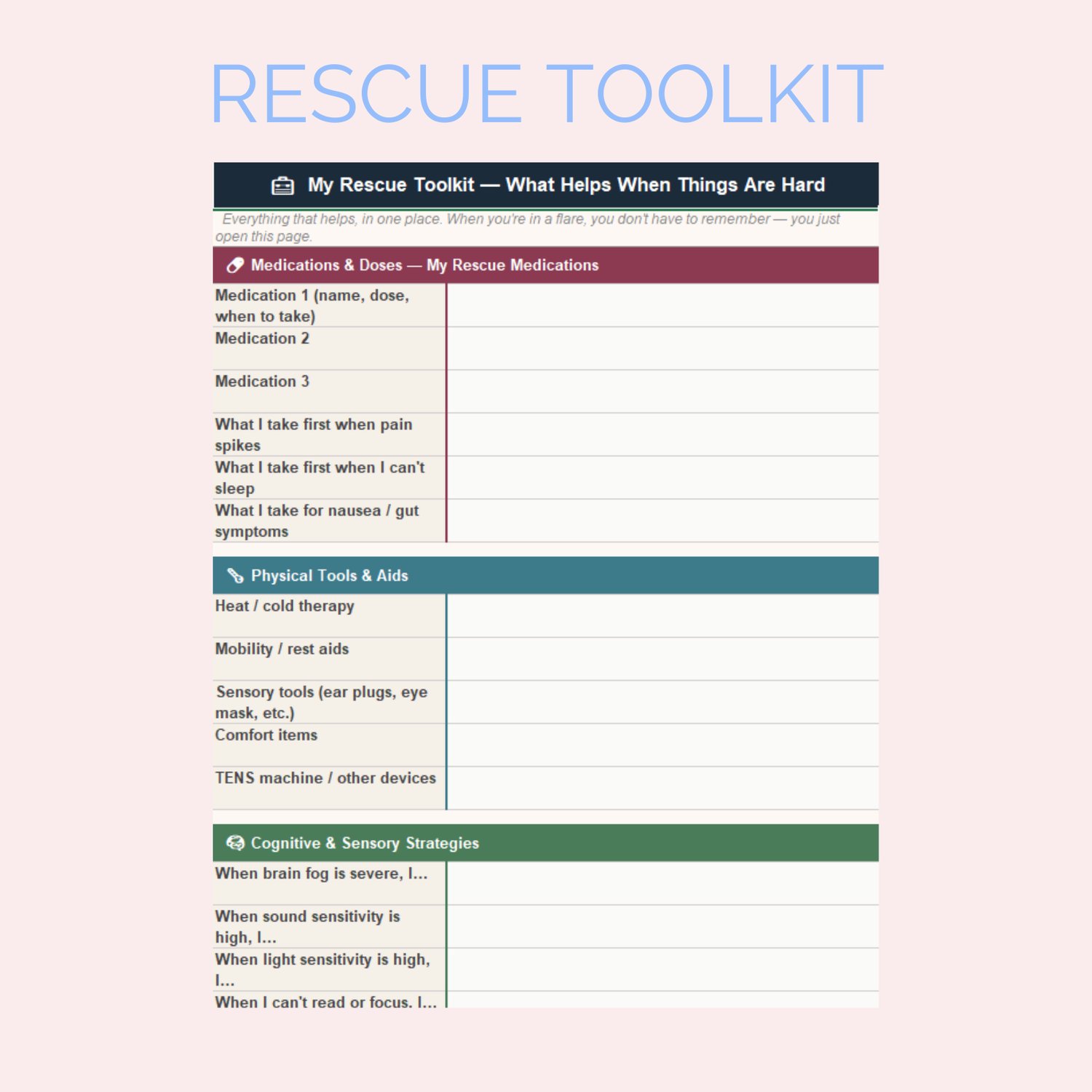
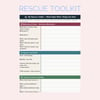
Rescue Toolkit — Everything That Helps, In One Place
When you're in a flare, you forget what helps. That's not forgetfulness — it's cognitive load.
The Rescue Toolkit is a single page that holds everything: your rescue medications and doses, your physical tools and aids, your cognitive and sensory strategies, your rest and sleep approaches, your emotional anchors, and your nutrition during flares.
You build it once, when you're thinking clearly, from your accumulated experience of what actually works. Then when you need it, you don't have to remember — you just open the page.
Also inside
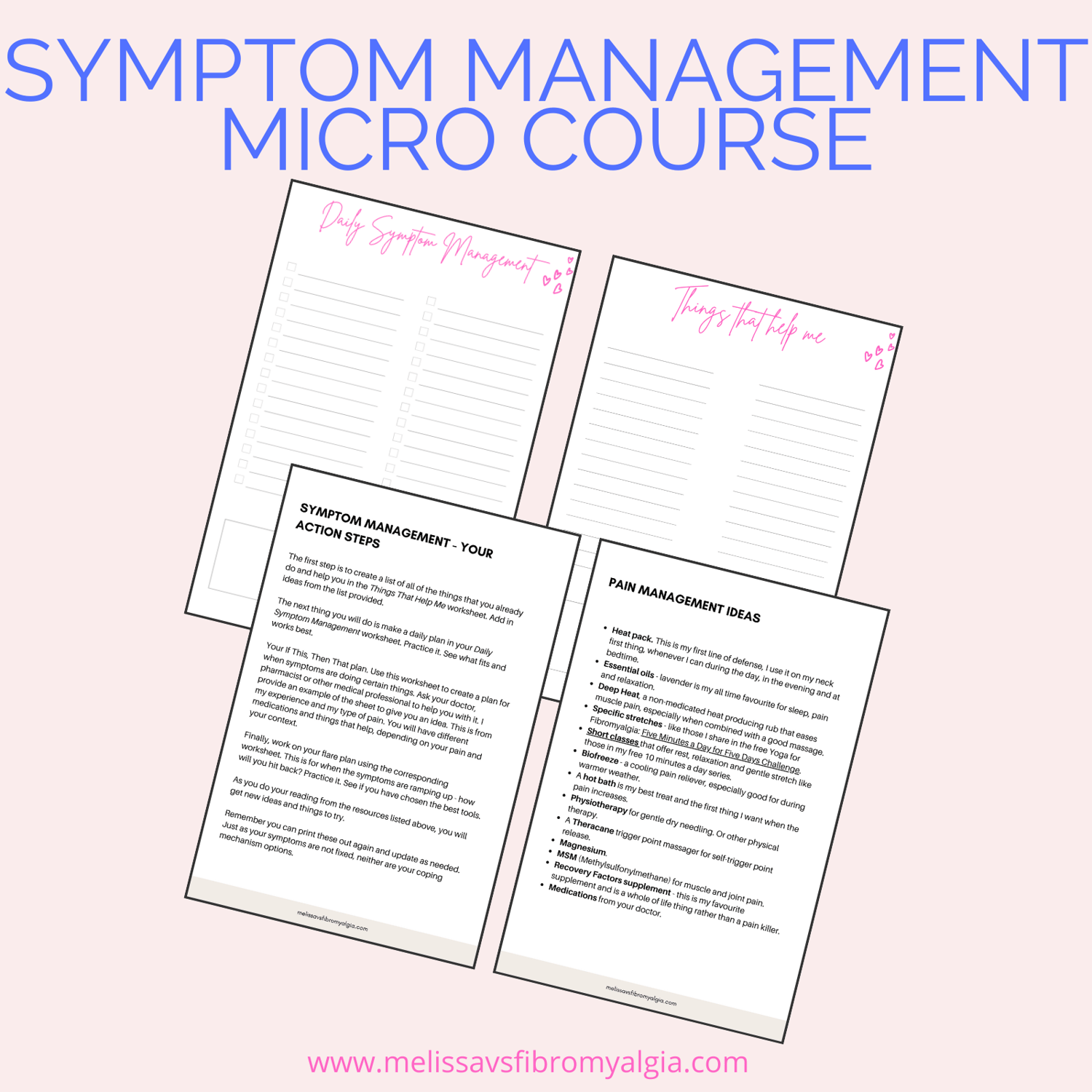
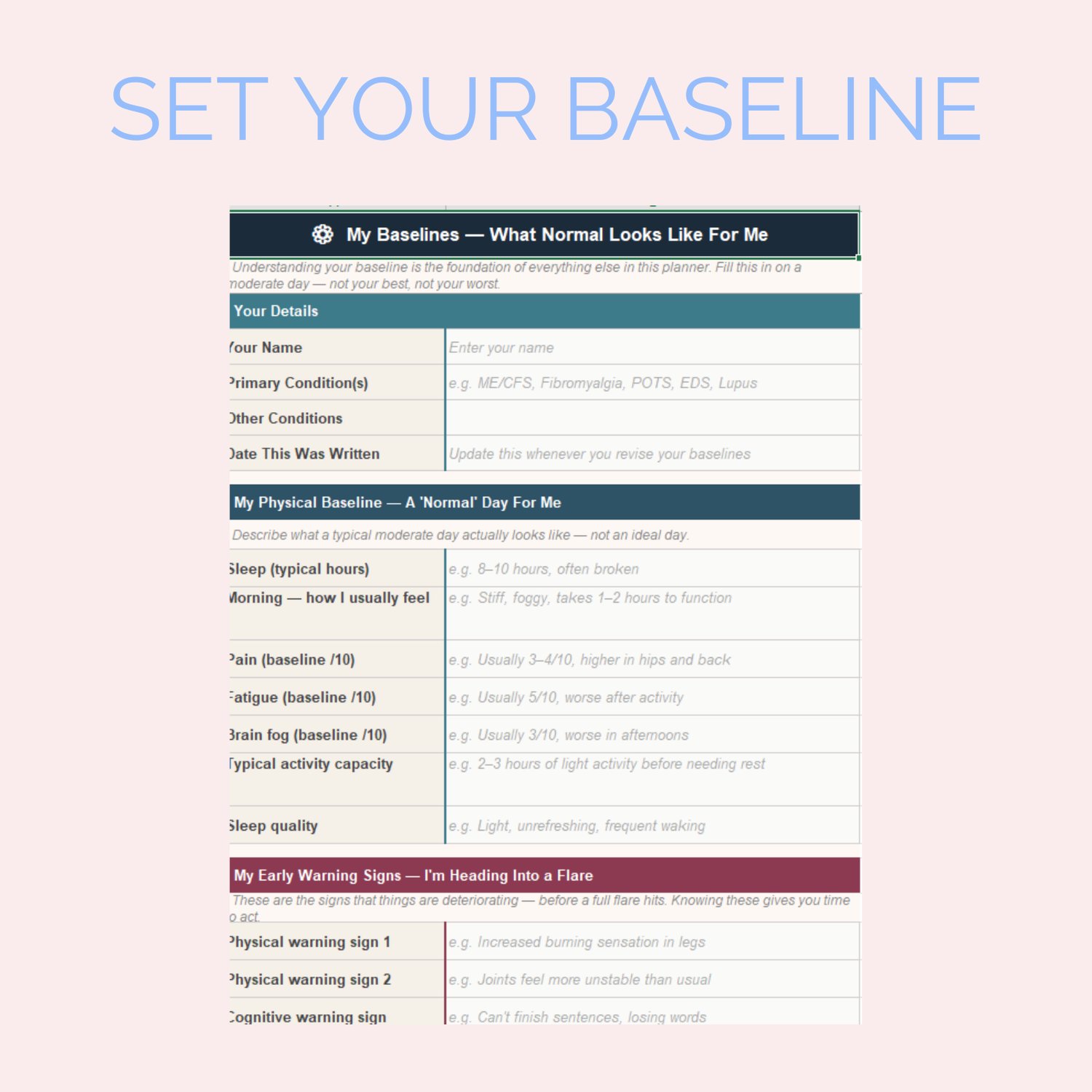
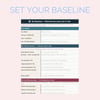
✓ My Baselines — your physical baseline, early warning signs, triggers, and what helps, all in one reference document
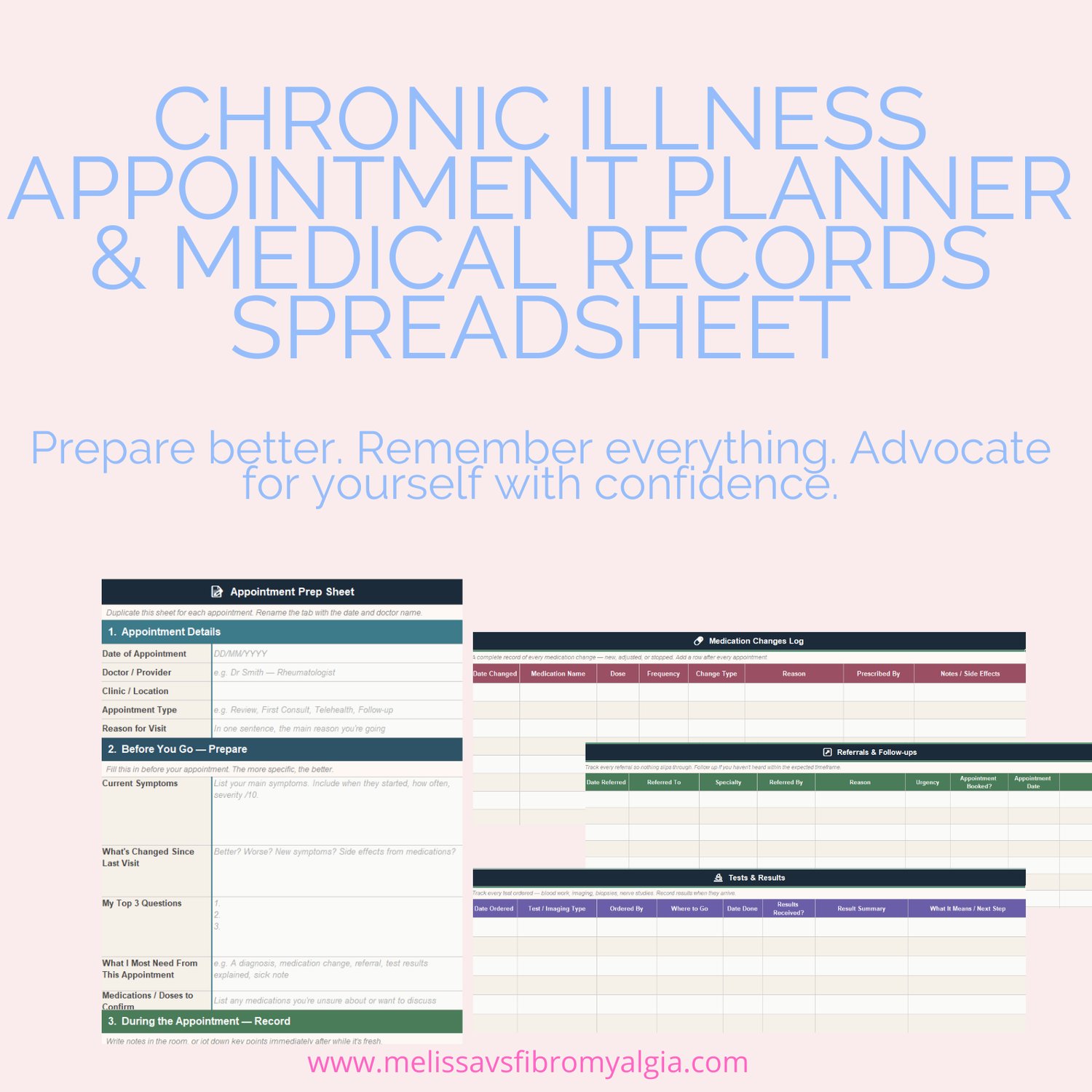
✓ My Support Plan — who to call at each level of need, what helps, what doesn't, and self-advocacy scripts for medical appointments
✓ Communication Scripts — 18 pre-written, ready-to-edit messages for cancelling plans, asking for help, explaining your condition, advocating for yourself, and protecting your energy
✓ Guide — warm, plain-language instructions written for people managing complex health needs
A word about the communication scripts
Finding words when you're unwell is one of the most draining things there is.
The Communication Scripts tab contains 18 messages — already written, ready to edit to your voice — covering situations like:
✓ Cancelling plans without over-explaining
✓ Asking a friend for practical help
✓ Explaining your condition to someone who doesn't understand
✓ Responding when a doctor dismisses you
✓ Asking for a referral you've been denied
✓ Setting a time limit on social events
✓ Saying no with kindness
These are not scripts to make you sound like someone else. They're starting points — written with your dignity intact — that you edit until they sound like you. Then they're there whenever you need them.
This planner is for you if
✓ You want to stop reacting to symptoms and start responding with a plan
✓ You've learned what your body does — and you want to protect that knowledge somewhere
✓ You struggle to know what to do when things escalate
✓ You've ever been in a flare and genuinely not known whether to push through or stop
✓ You need words for situations where yours fail you
✓ You're done fighting your limits and ready to understand them instead
✓ You want something you can share with the people who care for you — so they understand what you need without you having to explain it from scratch every time
An important note
This planner works best when you fill it in during a moderate period — not your worst days, and not your best. Not in a flare, and not in a burst of optimism when you're feeling unusually well.
The most valuable thing you can do is be honest. The "What NOT to Do During a Flare" section only works if you fill it in truthfully. The pacing guide only works if you rate your actual energy costs, not your aspirational ones.
This is not a document you show anyone else unless you choose to. It's for you. That means you can be completely honest in it.
What you receive
✓ One .xlsx file — instant digital download
✓ Compatible with Microsoft Excel (Windows and Mac) and Google Sheets
✓ Nine fully formatted, ready-to-fill tabs
✓ Colour coded throughout — severity levels, warning signs, urgency
✓ Personalised with your name via the Baselines tab
✓ 18 ready-to-edit communication scripts
✓ Complete guide tab inside the file
✓ Lifetime access — download and use forever for your own personal use (do not share the file)
Questions
How long does it take to fill in?
You don't have to fill it all in at once — and you shouldn't try. Start with My Baselines and the If This Then That tab. Those two alone are worth the purchase. Come back to the rest over several sessions, or whenever a particular tab becomes relevant.
Do I need Excel experience?
No. This is a form you fill in, not a formula you build. If you can click a cell and type, you can use this planner. The formatting, colour coding, and structure are all already done.
Does it work on Google Sheets?
Yes. Upload the file to Google Drive and open it in Google Sheets. Everything is fully compatible.
Can I share it with my carer or support person?
Yes — and this is one of the most valuable ways to use it. The Support Plan tab is specifically designed to be shared with the people who care for you. It tells them what helps at each level of need, what not to do, and what you need them to understand. It removes the burden of explaining yourself from scratch every time.
What if my symptoms change over time?
The planner is yours to update whenever you need to. Your baselines, your pacing costs, your flare plan — all of it changes as your condition evolves. Think of it as a living document rather than a one-time form.
Is this a physical product?
No — digital download only. You'll receive the .xlsx file immediately after purchase.
This tool is available for $9.99, so it's accessible to everyone.
You already know more about your body than any doctor ever will.
This planner helps you use that knowledge.