
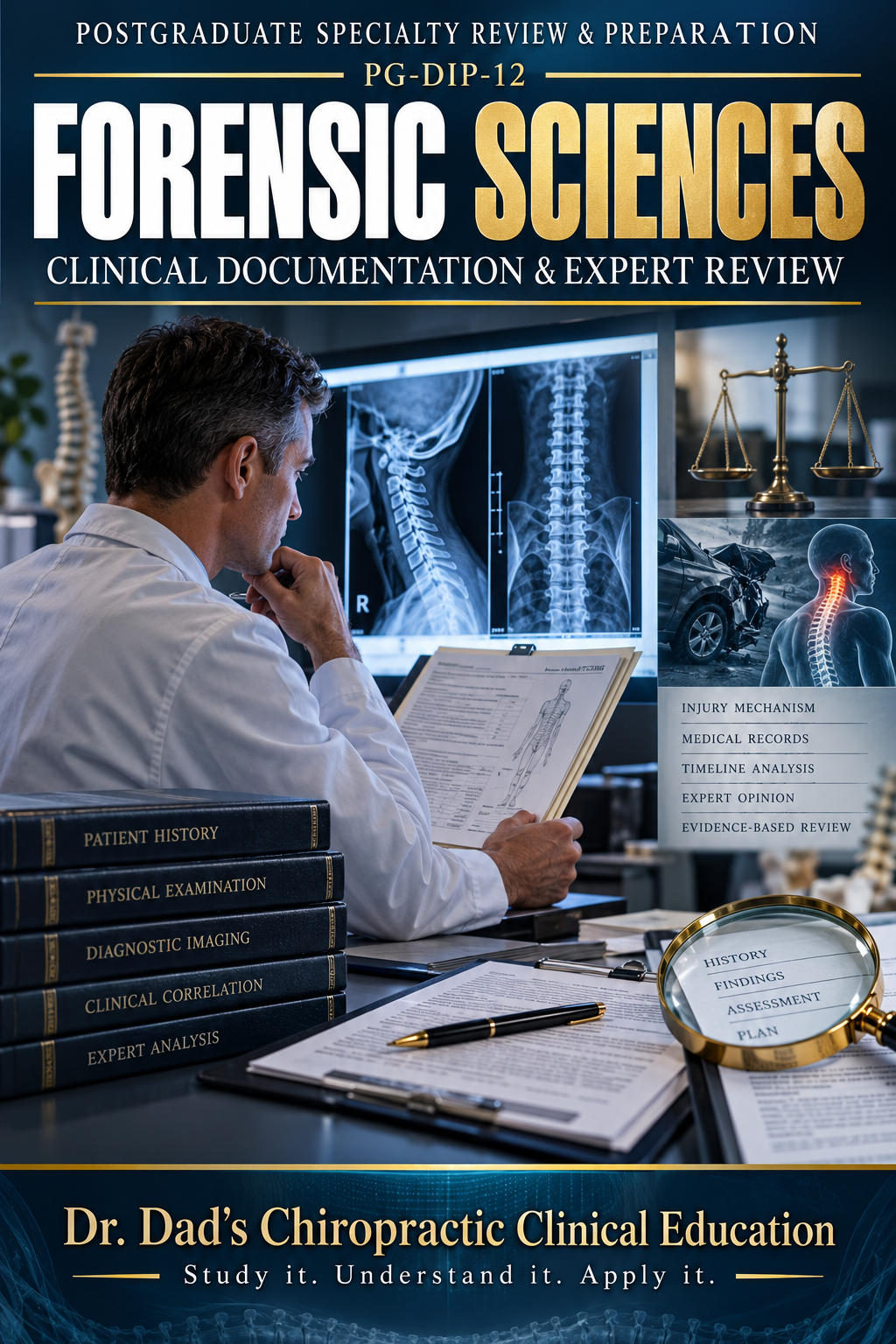
PG-DIP-12 FORENSIC SCIENCES
Clinical Documentation, Injury Analysis and Expert Review
Develop the analytical, documentation, and communication skills required when chiropractic care intersects with legal, insurance, disability, occupational, and personal-injury matters.
PG-DIP-12 | Forensic Sciences provides a structured introduction to the chiropractor’s potential role in forensic and medicolegal cases. It emphasizes objective clinical reasoning, accurate record review, injury-mechanism analysis, causation assessment, defensible documentation, and the clear communication of professional opinions.
The guide helps readers distinguish clinical findings from patient reports, assumptions, legal conclusions, and unsupported opinions. It also examines the responsibilities and limitations associated with treating-practitioner reports, independent evaluations, depositions, expert testimony, and interdisciplinary case review.
Topics include:
- Introduction to chiropractic forensic sciences
- The chiropractor’s role in medicolegal matters
- Treating practitioner versus independent evaluator
- Objective clinical documentation
- Medical-record and case-file review
- Chronology and timeline construction
- Injury-mechanism and biomechanical analysis
- Motor-vehicle collision considerations
- Occupational and personal-injury cases
- Clinical correlation of history, examination, imaging, and records
- Pre-existing conditions and prior injuries
- Causation, contribution, aggravation, and exacerbation
- Apportionment and competing explanations
- Consistency, reliability, and evidentiary limitations
- Maximum medical improvement
- Impairment, disability, restrictions, and functional limitations
- Prognosis and future-care opinions
- Independent medical and chiropractic evaluations
- Expert reports and professional opinion writing
- Depositions, testimony, and courtroom communication
- Working with attorneys, insurers, employers, and other professionals
- Ethical responsibilities, bias, conflicts of interest, and confidentiality
- Case-based forensic applications
- Rapid-review material and self-assessment questions
- A structured professional-development roadmap
- Practitioner preparation and case-review checklist
- Selected professional resources
Designed for:
- Chiropractors involved in personal-injury cases
- Clinicians reviewing motor-vehicle or occupational injuries
- Practitioners preparing medicolegal reports
- Chiropractors considering forensic or expert-review work
- Independent evaluators and record-review consultants
- Educators teaching documentation and professional reasoning
- Experienced practitioners seeking stronger defensibility and communication
A careful and defensible approach
This guide emphasizes impartial analysis, accurate documentation, evidence-informed reasoning, appropriate professional boundaries, and the clear acknowledgment of uncertainty.
It does not teach readers to act as attorneys, accident-reconstruction engineers, radiologists, or other specialists outside their education, competence, licensure, or jurisdictional authority.
Study it. Understand it. Apply it.
This is an independent educational resource. It does not award a forensic credential, establish expert-witness qualification, authorize independent examinations, expand professional scope, provide legal advice, or guarantee acceptance of an opinion by a court, insurer, employer, attorney, or administrative agency. Applicable laws, evidentiary standards, professional requirements, payer policies, and jurisdictional regulations should always be independently verified.