


6 Fourthwall Alternatives Offering Faster Payouts and Other Perks
Last updated: May 13, 2026
Fourthwall is a popular platform for selling merch and other products. However, it’s limited in what it can offer you. Some people look for Fourthwall alternatives to reduce their transaction fees as their revenue grows. Others want to sell a wider range of products, such as courses on their website, so they look for a platform that lets them sell more types of products.
Key Takeaways
- Payhip is the best alternative overall, allowing you to get instant payouts and sell a greater selection of products
- Redbubble offers you the opportunity to sell print-on-demand products
- Gumroad has a marketplace where you can sell your products
- Spring is a great choice for selling merch
- Patreon allows you to sell memberships under their brand
- Buy Me a Coffee enables you to accept tips and one-time donations
Why are people searching for Fourthwall alternatives?
1. They want better margins
Fourthwall takes a 5% cut on digital products and memberships. For beginners and low-volume sellers, this is a great price point. However, after you’ve generated thousands of sales, having to pay 5% per sale can eat away at your earnings. Instead, some platforms offer a 5% transaction fee with no subscription for beginners; however, they also have monthly subscription plans for sales with no transaction fees, so you get to pocket more money overall. Flat transaction fees with no plans to reduce costs can turn off the highest-volume sellers, prompting them to seek Fourthwall alternatives.
2. They want to own customer data
On Fourthwall, you do have access to customer emails, order history, and more, but it’s not as open or flexible as other platforms. You need to work inside their dashboard. While you can see your customer list and data, you don’t fully control the system around them. Most platforms allow you to export customers at any time, but Fourthwall tends to keep everything on the platform. There’s less emphasis and fewer features on exporting customers, using email tools, and other remarketing practices. The platform manages more of the relationship than Fourthwall alternatives, where you might be owning the relationship as a business.
3. They want to sell a greater selection of products
Fourthwall is known for its merch and creator storefronts. However, some creators want to sell more than just basic merch. Sometimes, they want to sell courses, ebooks, coaching, memberships, or other digital downloads. While you can sell digital products, Fourthwall lacks the unique functionality you need to do so. For example, if you wanted to create an online course for your audience, this platform would lack the built-in features you’d need, such as a built-in player, drip content, quizzes, assignments, completion certificates, and more. Overall, some Fourthwall alternatives let you sell a wider variety of products with deeper feature sets, too.
4. They want more marketing tools
Many sellers on Fourthwall are limited by the lack of marketing tools. Fourthwall lacks a native affiliate system, advanced discounts, upselling funnels, and sales flows. Beginners may not feel like they need these features. However, as their sales grow, they suddenly want more people selling for them, a higher average order value, and to run promotions. Most sellers need more than just a storefront; they need business tools to grow their sales. You’re not just trying to sell products, but to increase revenue.
5. They want faster payouts
On some Fourthwall alternatives, you can receive instant payouts. However, on Fourthwall, it can take 1 to 10 business days to receive funds after you’ve made a sale. US banks can expect payouts within 1 to 3 business days. However, if you’re outside the US, the wait time is much longer, between 3 and 10 business days. Overall, in a world where instant payouts are possible, the wait time on Fourthwall has people looking for alternatives to Fourthwall.
Comparing Fourthwall Alternatives
| Platform | Best For | Pricing | Key Pros | Key Cons | Best Overall Verdict |
|---|---|---|---|---|---|
| Payhip | Creators selling digital + physical products, memberships, courses | Free: 5% fee Plus: $29/mo (2%) Pro: $99/mo (0%) |
Instant payouts, all features on all plans, advanced marketing tools, supports many product types, marketplace access | No native merch fulfillment | Best overall Fourthwall alternative for flexibility and growth |
| Redbubble | Print-on-demand marketplace sellers | 20%–50% platform fee | Built-in marketplace, passive income potential | Very high fees, no brand ownership, high competition | Best for side hustle POD |
| Gumroad | Indie creators selling digital products | 10% + $0.50 +30% marketplace fee |
Marketplace exposure, simple setup | High fees, limited ecommerce features, weak for merch | Best for digital creators |
| Spring | Merch creators and YouTubers | ~20% + $1.70 fee per sale | Print-on-demand, integrates with YouTube | Not an all-in-one platform, limited customization, no digital products | Best for YouTube merch |
| Patreon | Memberships and fan subscriptions | 10% + fees + 30% App Store fee | Strong community tools, recurring income | Expensive, no ecommerce, limited branding | Best for memberships |
| Buy Me a Coffee | Creators accepting tips and donations | 5% transaction fee | Simple, low-maintenance, easy to set up | Low earning potential, limited features, no marketplace | Best for tips |
6 Fourthwall alternatives offering faster payouts and other perks
1. Payhip

Payhip is a Fourthwall alternative that lets you sell more than just physical products to your customers or followers. Each seller will have access to all features on all plans, even the free one. There are no revenue caps, either.
This Fourthwall alternative enables you to grow your sales by offering advanced marketing tools that are easy-to use. You can create an affiliate program that lets other sellers promote your products for you. You’ll be able to add upsells and cross-sells to your products to generate more sales for yourself. Overall, it’s easier to increase your overall sales with Payhip.
Finally, unlike Fourthwall, you can list your products on the Payhip Marketplace once you’ve made $10 in sales. Beyond building your own audience list, you’ll also be able to tap into an existing audience, giving your product even more visibility.
Pricing
Free Forever
- $0/month
- 5% transaction fee
Plus
- $29/month
- 2% transaction fee
Pro
- $99/month
- No transaction fees
Pros
- Offers all features on all plans, even the free plan
- Specialized features for digital and physical products, such as drip content, quizzes, certificates for courses, license keys for software, and PDF stamping for ebooks
- Instant payouts with Stripe and PayPal
- Easy to use and set up
- Allows you to sell a greater selection of products, such as courses, memberships, coaching, digital downloads, and physical products
- Offers more flexible models, such as one-time purchase, subscriptions, bundles, and more
- Better suited for membership sites than Fourthwall
- Offers built-in marketing tools, such as an affiliate program, coupons
- Allows you to sell unlimited products with no caps or fees for listing items
- Handles VAT and sales taxes automatically
- Connects to over 100 payment gateways
- Better suited for large collections than Fourthwall
- Has a marketplace where you can sell products
Cons
- No native merch fulfillment
Sell Digital Products with Payhip
No monthly fees. No tech headaches.
2. Redbubble

Redbubble is another Fourthwall alternative, where you can create and design your own products and have them shipped by the manufacturer. It’s more of a print-on-demand marketplace than a tool to help you build a business to sell to your customers or followers. Though this marketplace can get somewhat competitive with the 700,000 sellers on the platform.
Unlike Fourthwall, you’ll likely have a larger share of your profit margin eaten up by the high fees. A new user will likely be on the standard account, which takes half of the pie. Overall, this platform is better suited to people looking to make some passive income on the side, rather than build something long-term and sustainable.
Pricing
Platform fee
- 20% (Premium accounts)
- 50% (Standard accounts)
Product markups above 20% fee
- 50%, on earnings above 20%
Pros
- Built-in marketplace
- Allows you to create print-on-demand products
Cons
- More expensive than Fourthwall, giving you less profit
- Lacks fee reduction at scale
- No ability to build a brand
- Won’t have access to customer data or emails to remarket
- More aligned as a side hustle than a serious business
- Can be removed from the platform anytime
- Hard to stand out in the marketplace
- Must price compete to get sales
- Limits on daily uploads
- Strict copyright takedowns with a likelihood of rejected appeals, even if it’s your own design
- Not well-suited for selling digital products
3. Gumroad
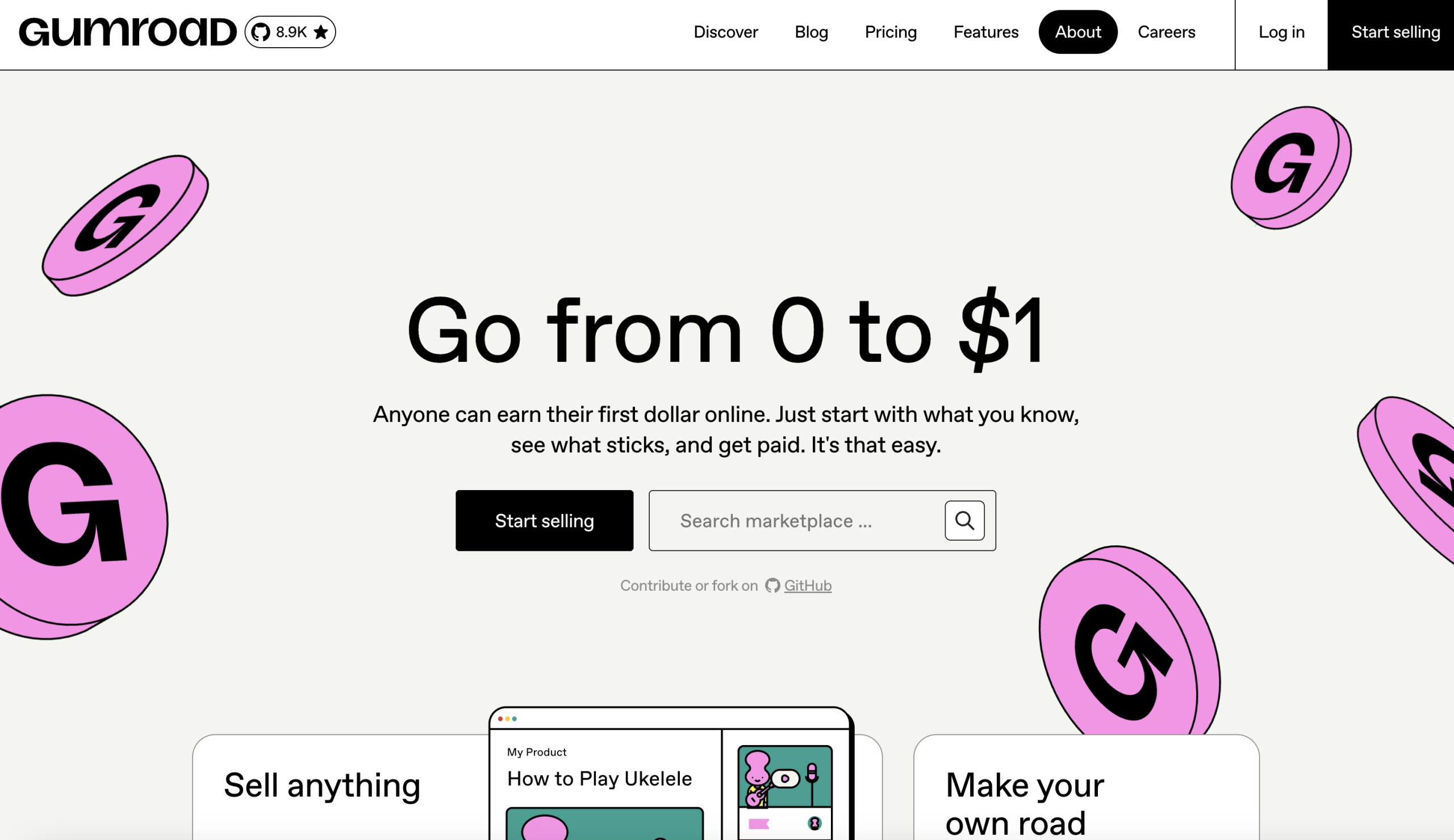
Gumroad is one of the Fourthwall alternatives with a marketplace. However, despite having a built-in marketplace to sell products, you pay a 30% fee per transaction for getting sales from there. On top of that, Gumroad isn’t a platform that offers advanced functionality for selling physical products. Plus, there are multiple rules around physical products, such as dropshipping being banned on the platform. Beyond that, you can’t sell jewelry on the platform either.
Gumroad is not only more expensive than Fourthwall, but it also feels less like a store and more like a checkout page. Most people don’t only want a link-in-bio feature, as that only works for social media. Most sellers also get traffic organically via search and LLMs, which tends to be the biggest source of sales. The tool’s limited functionality makes it less ideal for serious sellers looking to build a lasting business.
Pricing
Gumroad Pricing
- 10% + $0.50 per transaction
- 30% per transaction through the marketplace
Pros
- Built-in marketplace to promote your products
- Popular amongst indie creators
Cons
- More expensive than Fourthwall
- Marketplace fees are high compared to Fourthwall alternatives
- Limited customizations for storefront
- Feels less like a store and more like a checkout page
- Not ideal for merch or physical products
- Lacks print-on-demand integrations or functionality
- Lacks basic ecommerce features, such as a storefront
- Not an all-in-one platform
4. Spring

Spring is a Fourthwall alternative that offers print-on-demand solutions for creators and online retailers.
Unfortunately, that means it also lacks the ability to sell digital products like ebooks, courses, software,
memberships, and coaching services.
Spring is better suited for merch creation rather than building a branded website. They have a large product catalog of items you can put your designs on. However, beyond this, it’s not really an all-in-one platform with complete ecommerce capabilities.
Pricing
Spring Pricing
- 20% + $1.70 processing fee per transaction
- Specialized rates per product for physical products
Pros
- Sell directly under YouTube videos
- Built-in print-on-demand with a large product catalog
Cons
- Less brand control than Fourthwall
- Is more of a merch tool than a branded website builder
- Not an all-in-one platform, limiting what you can sell
- Less ideal for digital products, memberships, or services
- Fewer customization options compared to Fourthwall
5. Patreon

Fourthwall alternatives like Patreon focus exclusively on creating a membership platform with your fans or followers. Unlike Fourthwall, you won’t be able to sell digital products, merch, or other items.
This Fourthwall alternative is more expensive than Fourthwall, with no fee reduction at scale. Plus, there are hidden fees, such as an App Store fee for those customers who sign up via their iPhones.
If you’re hoping to build a recognizable brand on Patreon, this might be a sign that this isn’t the best platform for you. There’s also no way to get new followers from Patreon itself, as you’ll be bringing members to their platform, not the other way around. Overall, the value you get is lower than building a membership site on your own website, where at least you’d own your customer data.
Pricing
Patreon Pricing
- 10% of the income earned
- 2.9% + $0.30 payment processing fee
- $0.25 – $1.00 payout fee
- 30% App Store fee for in-app purchases
Pros
- Allows you to charge recurring subscriptions to fans
- Has strong community features allowing fans to add comments, polls, messages, and more
Cons
- Many fees have high costs
- No way to reduce the percentage of fees at scale
- Unbranded webpage as it’s hosted on Patreon
- Limited design customizations
- Not ideal for ecommerce or merch
- Fewer products you can sell compared to Fourthwall
- Isn’t a website builder
- Hard to transition members from free to paid plan
- Requires you to put out a lot of content to keep members engaged
6. Buy Me a Coffee

Buy Me a Coffee is a Fourthwall alternative where you can collect donations and tips. Many people will add it to their email signature when helping people online, particularly website owners, where knowledge is shared.
You’ll likely earn more with Fourthwall than with Buy Me a Coffee, which is typically used as a platform to donate the average cost of a cup of coffee.
The platform doesn’t have any built-in marketplace or discovery tool to help you find new customers. You’ll need to drive your traffic to your page, not the other way around. You also only get a profile page rather than a website, so you’ve got limited options for branding, too.
Pricing
Buy Me a Coffee Pricing
- 5% transaction fee
Pros
- Great for one-time donations or tips
- Low-maintenance platform
Cons
- Fee on all transactions, unlike Fourthwall, which doesn’t put it on all product types
- No fee reduction at scale
- Fewer options for pricing strategies
- Revenue potential is lower than Fourthwall
- You only get a profile page rather than a website
- Less professional aesthetic at scale
- Not ideal for selling large catalogs of products
- Limited functionality for digital products with fewer specialized features
- Lack of marketing tools
- No built-in marketplace or discovery tool
- First payout takes up to 14 days, after that it’s about 3-5 days
FAQ
What are the best Fourthwall alternatives?
The best Fourthwall alternatives are Payhip, Redbubble, and Patreon.
Can I build a website with a Fourthwall alternative?
Yes, you can build a website with the Fourthwall alternative Payhip. You can fully customize your entire website by accessing free themes and adding your own content. You’ll be able to sell a wide range of products from digital to physical with specialized features for each product type. You’ll also have access to marketing tools that help you make higher revenue.
Are there cheaper alternatives to Fourthwall?
Yes, the cheaper alternative to Fourthwall is Payhip. This Fourthwall alternative has a free plan with a 5%
transaction fee. However, as your sales grow, you can reduce your transaction fees by switching to a paid plan, which keeps your total cost lower than Fourthwall’s. Unfortunately, Fourthwall doesn’t reduce transaction fees at scale.
Are there platforms with no monthly fees like Fourthwall?
Yes, Payhip offers a free plan with no monthly fees, unlike Fourthwall. You only pay a 5% transaction fee per sale.
Which Fourthwall alternatives are best for beginners?
The best Fourthwall alternative for beginners is Payhip, which offers a free plan that keeps your wallet in check as you learn to get your first few sales. It also has an intuitive design, making it quick and easy to set up your store without technical experience. This no-code platform also has a range of features that allow you to get support in marketing your product, such as an affiliate program, Payhip Marketplace, and more.
Payhip vs Fourthwall: Which is Better?
Unlike Fourthwall, Payhip offers unlimited storage, 24/7 human support, instant payouts, and a marketplace where you can sell digital and physical products to an existing audience. Overall, Payhip is the better option, with more features for beginners and for scaling your business.


Payhip
Join over 130,000 creators who have launched their businesses selling digital products, online courses, memberships, coaching, and physical products.
Get started for free today
Comments
Leave a Comment