


6 Best Whop Alternatives to Make Money Online in 2026
Last updated: March 31, 2026
Whop is a platform known for its high fees, particularly on its marketplace, which takes a 30% cut of sales. The marketplace is often considered too competitive for sellers, making it harder for them to achieve the visibility they need on the platform. They also don’t have a native video player; you’d have to embed YouTube or Vimeo videos to add video content as a course creator. Overall, several issues with the platform may cause people to turn away from it. In this post, we’ll share 7 Whop Alternatives you can try instead.
Why Are People Leaving Whop and Looking for a Whop Alternative?
1. Revenue Unpredictability
Many Whop sellers struggle to make sales. Their online shops will get page visits that just don’t convert. Since Whop is mostly known for its marketplace, people expect to achieve higher sales volume organically through their listing rather than through their own marketing. You need to have a built-in audience already in place to see sales from your products. There’s no guarantee that you’ll make money on this platform using their marketplace. Plus, funds are sometimes withheld, and accounts are sometimes suspended. You can have funds held for over 90 days if you have high sales volume or if your account is flagged. Some have even lost money without any proof of their violation.
2. High Fees
Whop isn’t a one-fee platform, which can prompt sellers to seek alternatives to Whop. It has multiple fees for different circumstances. When those fees are combined, they create challenges for profitability. For instance, Whop charges per transaction fees for the following:
- 3% transaction fee for Whop Payments
- 30% marketplace fee
- 2.7% + $0.30 card fee
- +1.5% addon fee for international card
- +1% addon if currency conversion is needed
- 15% fee through financing partners
- 1.5% fee for collecting ACH payments
- $2.50 fee for every payout
- 4% + $1.00 fee for instant bank deposit
- 5% + $1.00 fee for accepting crypto
- 5% + $1.00 fee for accepting Venmo
- $23.00 for every bank wire
- $0.03 fee for 3DS
- $0.07 fee for Radar
- $15.00 fee for every chargeback or dispute
- $29.00 fee for every early dispute alert (RDR)
- 0.8% fee for Orchestration
- 0.5% fee for billing
- 0.5% for tax and remittance
3. Platform Issues
Another challenge causing people to switch to Whop alternatives is that Whop sellers don’t own their audience, their payments, or their platform. That means you won’t be able to remarket to buyers with email marketing or retargeting ads. You also have to fork up various fees. For instance, if you were running ads on your own website, you’d pay less in fees than the 30% marketplace fee, while still driving traffic to your site. The Whop platform can also terminate your account at any time, without evidence being shown to you. Sometimes, accounts get flagged and removed by employees. Overall, you probably notice that you’re better off selling on another platform.
4. Marketplace Quality
You might turn to a Whop alternative as the marketplace is packed with other sellers competing for the same buyers. Anyone can list their product in the marketplace, so there tend to be lower-quality products and sometimes even spammy ones that drown out the product you put effort into creating. There’s an abundance of make-money products that look similar, making it harder to stand out on the platform. Plus, there’s just a lot of competition that reduces your visibility on the platform. While the marketplace is good for early traction, depending on it can hurt your total sales.
5. Limited growth
Another reason why you might look for Whop alternatives is that you’ll need to do your own marketing. Most website builders require you to do your own marketing to get those first few sales. However, Whop doesn’t offer the tools to make selling online even easier. For instance, they don’t have a referral program, upsells or cross-sells, or even discount codes to help you sell more products.
| Platform | Best For | Pricing | Key Pros | Key Cons | Best Overall Verdict |
|---|---|---|---|---|---|
| Payhip | Creators selling digital products, courses, memberships, coaching, software, and physical products | Free: $0/month + 5% fee Plus: $29/month + 2% fee Pro: $99/month + 0% fee |
Low fees, built-in video player, marketplace access, supports many product types, affiliate/referral/upsell tools, VAT and tax handling | No built-in Discord or Telegram community | Best Whop alternative overall for flexibility, low fees, and built-in selling tools |
| Shopify | Traditional ecommerce stores, especially physical products | Basic: $39/month Grow: $105/month Advanced: $399/month Plus: $2,300/month |
Popular brand, large app ecosystem, many themes, strong for online store building | No free plan, extra fees from apps, weaker for digital products, more complex setup | Best for physical-product ecommerce, not ideal for creators selling digital goods |
| Podia | Course creators, digital downloads, coaching, webinars, communities | Mover: $33/month + 5% fee Shaker: $75/month |
Built-in video hosting, all-in-one creator tools, more built-in features than Whop | No marketplace, no free plan, can be expensive for beginners | Best for creators who want simplicity and built-in course tools |
| Patreon | Recurring memberships and fan communities | 10% platform fee + payment processing and extra fees | Strong brand recognition, community features, built-in video/livestreaming, email export | Expensive over time, limited discoverability, mainly for memberships | Best for fan-supported memberships, less ideal for broader product selling |
| Etsy | Handmade and craft sellers, some digital product sellers | Setup fee: $15–$29 Listing fee: $0.20/item Transaction fee: 6.5% Additional ad and payout fees may apply |
Large built-in audience, easy to set up, high customer trust | High competition, many fees, weak customization, not ideal for digital-first businesses | Best for marketplace exposure, but weaker for brand ownership and repeat marketing |
| Teachable | Creators focused only on online courses | Starter: $39/month + 7.5% fee Builder: $89/month Growth: $189/month |
Advanced course tools, quizzes, certificates, progress tracking | No free plan, expensive, course-only focus, lacks built-in community and marketplace | Best for course specialists who need deeper learning features |
6 Best Whop Alternatives to Make Money Online in 2026
1. Payhip
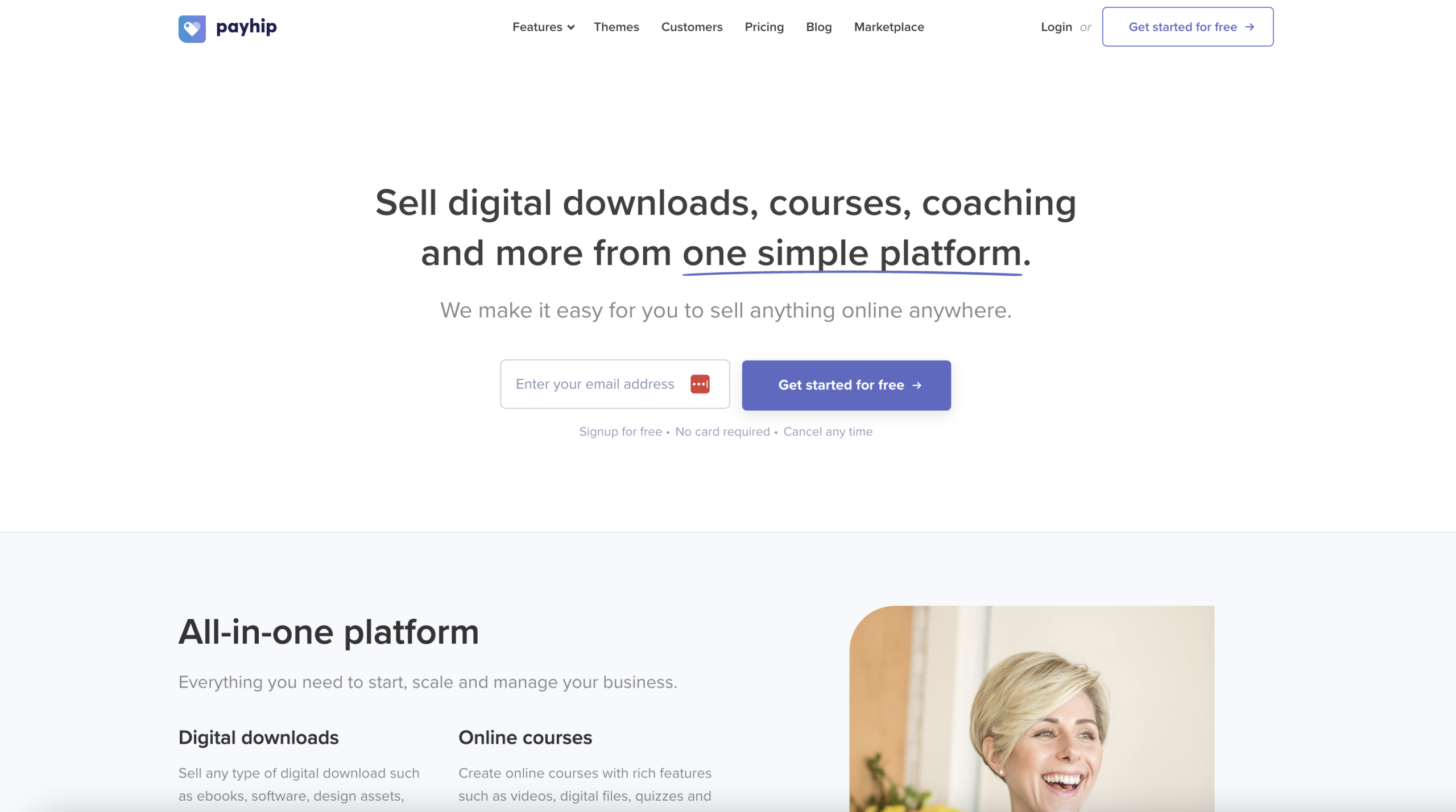
Payhip is the best Whop alternative on the market for several reasons. First, it has one of the lowest fees you’ll find online. You can sell your digital or physical products on the Payhip Marketplace without any added fees. They only take a 5% cut of the sale. There is also no monthly subscription fee.
Payhip also offers a beautiful, built-in video player for selling online courses, unlike Whop, where you’ll end up embedding YouTube or Vimeo videos instead. The course creator also lets you drip content and issue quizzes, assignments, and certificates.
You’ll be free to sell physical products, unlike Whop, as well as create membership sites, sell any digital download, create online courses, sell software with unique license keys, and offer coaching services on this platform. So, if you’re a nutritionist offering coaching services, you’ll be able to sell physical copies of a cookbook you create to help people plan their meals.
Accessing a marketplace is also a possibility on this platform. There are a variety of niches you can sell in, helping you gain more visibility for your products. This marketplace is less competitive as it requires at least $10 in sales to be considered.
Payhip also automatically handles VAT and sales tax, so you don’t have to worry about the tax laws of the EU/UK.
PRICING
The Whop alternative lets you reduce your transaction fees as your sales start rolling in with paid plans. The free plan gives you the time you need to grow your sales without paying any subscription fees. As you start making sales, you can lower your transaction fees by signing up for a paid subscription; that way, you pay only one fee each month. All plans have all features, unlimited products, and no revenue caps.
You’ll have the option to choose between three pricing plans:
-
- Free Plan: $0/month, 5% transaction fee (perfect for beginners)
- Plus Plan: $29/month, 2% transaction fee
- Pro Plan: $99/month, no transaction fees
PROS
-
- Most affordable Whop alternative
- Less competitive marketplace to Whop
- Built-in features for selling digital and physical products, such as:
-
- Digital downloads: PDF stamping on ebooks to prevent piracy
- Online courses: built-in course player, unlike Whop, multiple lesson types, certificates for students
- Coaching: Calendly and Zoom integrations for scheduling meetings and hosting video calls
- Subscription of membership: charge recurring fees to members when sharing exclusive content
- Software: generate license keys or upload your own
- Physical products: easily manage inventory and order fulfillment
-
-
- Get instant payouts with PayPal and Stripe, or choose from over 100 other payment gateways
- Collaborate with up to 4 other creators to launch your products
- Access easy-to-use marketing tools, such as an affiliate program, referral system, upselling, cross-selling, coupon
codes, and more
CONS
-
- Doesn’t have built-in Discord or Telegram communities as a channel
2. Shopify

Shopify is one of the most popular platforms for building an online store, making it a common Whop alternative to choose from. They own a marketplace called Shop where you can sell your products to a global audience. However, since there are millions of sellers on the platform, the marketplace can get quite crowded, reducing your visibility.
Shopify also doesn’t have a free plan, so you’ll be on the hook of paying a subscription even if your store doesn’t make any sales. They’re also known to have high fees, particularly due to the fact that they have an app store, instead of building in more features natively into the product. Plus, you’ll likely have to pay for a theme if you want one with a good design.
The biggest disadvantage to using Shopify as a Whop alternative is that they don’t have features built-in for selling digital products. You’ll need to install a third-party app to do so, which can drastically increase your overall fees, thus, reducing profitability.
PRICING
On Shopify, you’ll have the option to choose from four pricing plans. These are USD prices as of March 26, 2026.
Basic Plan:
-
- $39/month
- 2.9% + $0.30 online
- 2.6% + $0.10 in person
- 2% 3rd-party payment providers
Grow Plan:
-
- $105/month
- 2.7% + $0.30 online
- 2.5% + $0.10 in person
- 1% 3rd-party payment providers
Advanced Plan:
-
- $399/month
- 2.5% + $0.30 online
- 2.4% + $0.10 in person
- 0.6% 3rd-party payment providers
Plus Plan:
-
- $2,300/month (on a 3-year term)
PROS
-
- Offers 800+ themes to help you customize your own online store
- Owns a marketplace where you can sell products online called Shop
- Has all the tools you need to run your online store, particularly through add-on apps
CONS
-
- Primarily known for selling physical products, not a good platform for digital products
- Fees can skyrocket quickly when adding apps from the app store to your website
- Charges additional transaction fees when not using Shopify Payments
- Harder to set up and build an online store
- Lacks built-in features for building a community or membership site
3. Podia
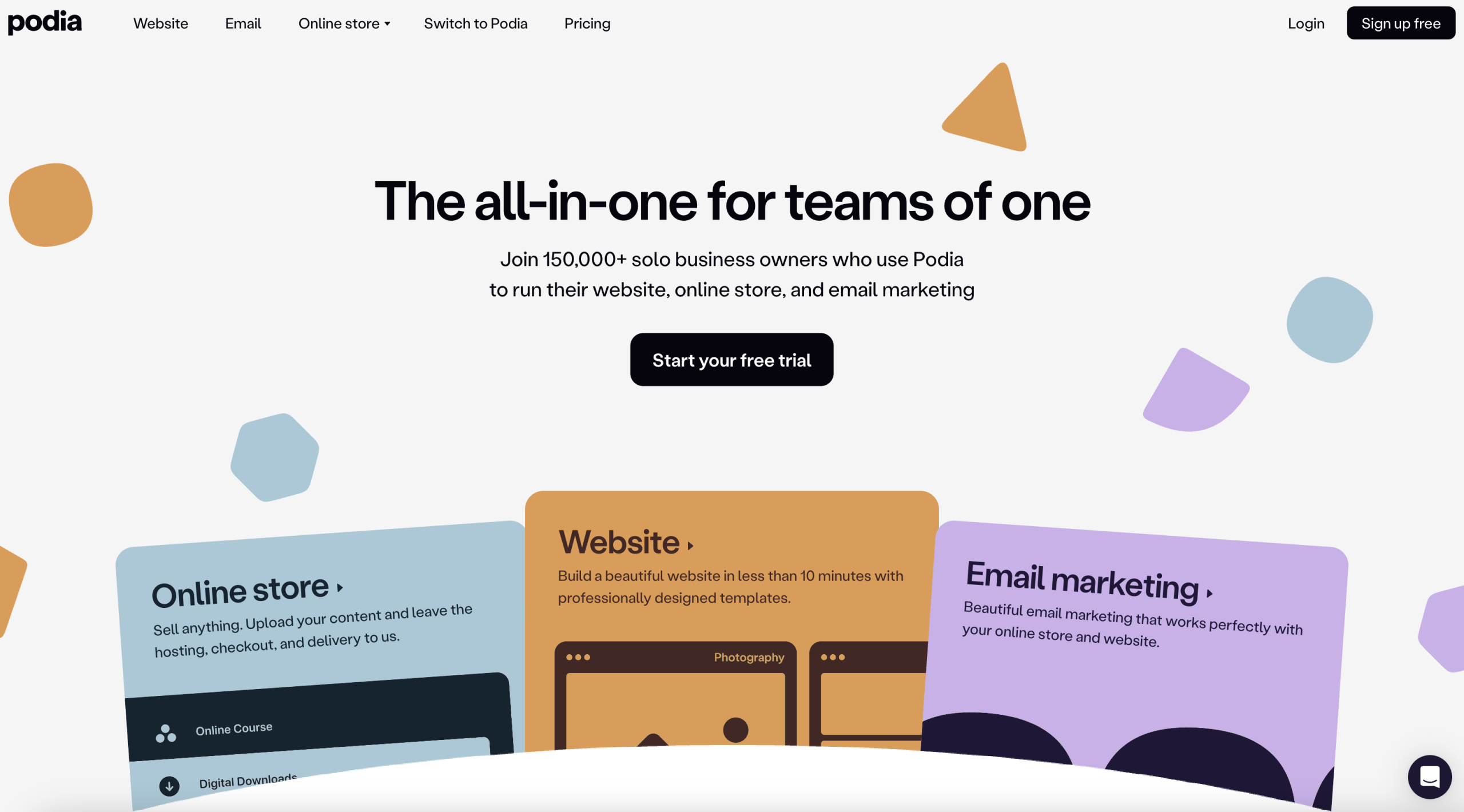
Whop alternatives like Podia allow you to sell online courses, digital downloads, coaching, webinars, and build a community. Podia is a more expensive platform than Whop as you’ll have to pay both a subscription and a transaction fee on its lowest plan, making it a subpar choice for beginners.
Podia has built-in video hosting that allows you to have online courses on your website without needing to embed YouTube or Vimeo videos. Overall, you’ll find more built-in features on the platform as it’s more of an all-in-one tool.
However, this Whop alternative doesn’t have its own marketplace, unlike other Whop alternatives. Thus, you’ll really need to work on enhancing those marketing skills to help you achieve the sales volume you’re after.
PRICING
Podia has only two pricing plans. Unfortunately, they don’t currently have a free plan. They only have a 30-day free trial to test out the platform. However, if you don’t make a sale in your first thirty days, you’ll still be on the hook for paying a monthly subscription that tends to be a bit on the higher side. Here’s a look at the two plans:
Mover:
-
- $33/month
- 5% transaction fees
Shaker:
-
- $75/month
PROS
-
- Offers a greater selection of design options for storefronts
- Podia is more affordable than Whop once you’ve achieved high sales volume
- Includes a built-in video player for online courses
CONS
-
- An expensive platform for beginners
- Limited design flexibility
- Lacks an affiliate marketing program on the Mover plan
- Lacks strong integration with Discord and Telegram
- Doesn’t have software license keys or cryptocurrency offerings
4. Patreon

If you’re looking to create a membership platform for your fanbase, you might want to check out Whop, an alternative to Patreon. It’s a bit pricier than Whop; however, it’s a popular choice among content creators.
On this platform, you’ll be able to build a community via chats, DMs, and comments. You can also export your email lists to send emails to your community and keep them engaged. The platform also has built-in video and livestreaming. If you’re a podcaster, you can manage your podcast on the platform.
However, this Whop alternative has few options available for creators to get discovered. You’ll need to grow your own followers on another platform and bring them over to the platform.
PRICING
Patreon only has one price on its platform. It’s a transaction fee that doesn’t decrease with the volume of members. Unfortunately, this can make it much more expensive than Whop, particularly for building a community.
Patreon Pricing:
-
- 10% of the income you earn on Patreon
- 2.9% + $0.30 USD for payment processing, which can vary per payment gateway
- 2.5% currency conversion fee
- $0.25- 1% payout fee
- 30% on eligible purchases made on Patreon’s iOS app
PROS
-
- Allows for more customization than Whop
- Has more brand recognition than Whop
CONS
-
- Designed for recurring memberships only
- Most creators struggle to transition members from the free tier to the paid one
- Lacks tools for discoverability
- No native community features, such as integrated Discord or Telegram
- Primarily for monthly billing; lacks more flexible pricing options
5. Etsy
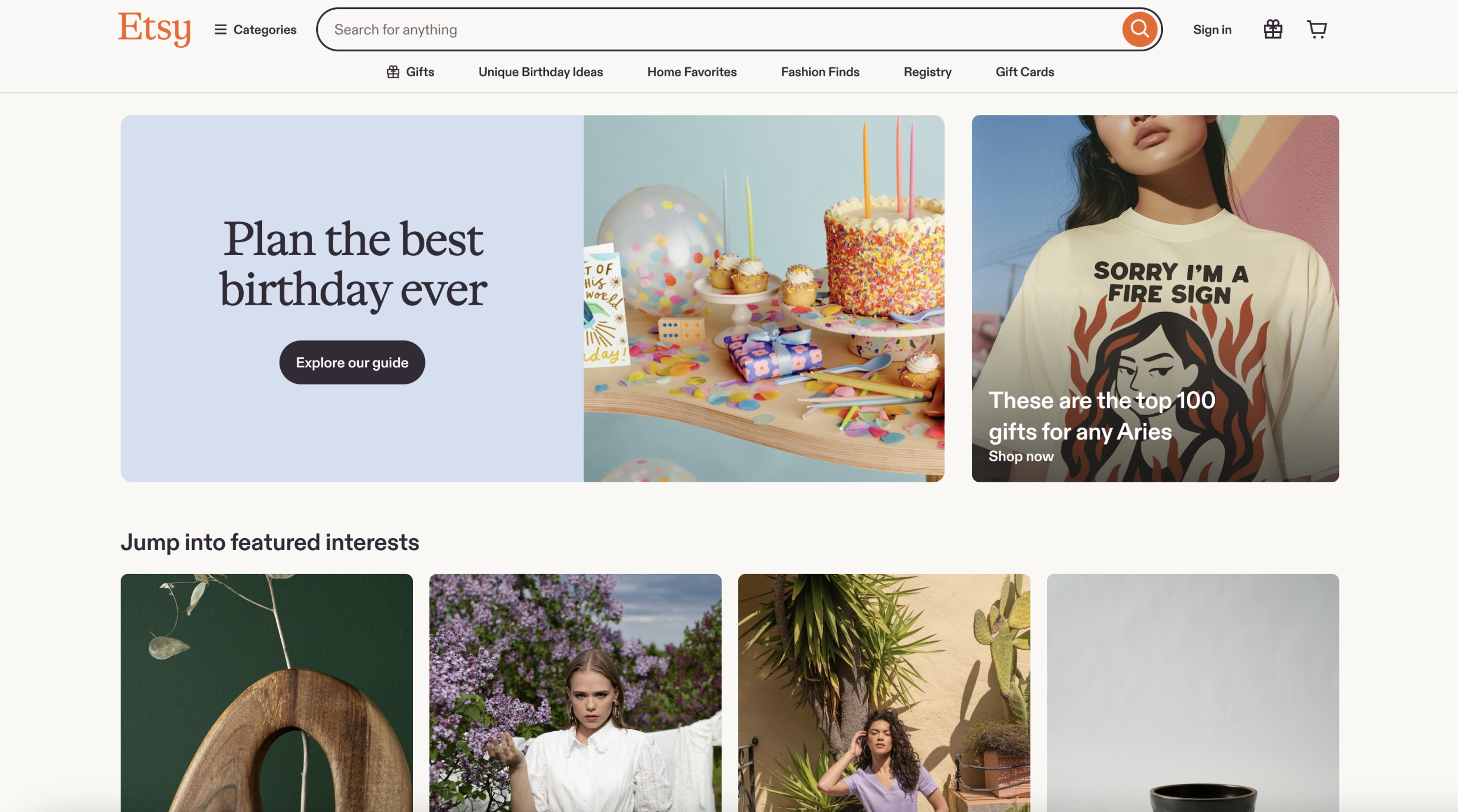
Etsy is a popular marketplace known for its handmade goods, but allows people to sell their digital products on the platform as well. Due to its mass appeal, it has higher fees than most platforms, making it an expensive Whop alternative.
Etsy has a lot of brand recognition that makes shoppers feel safe shopping on their website. Their marketplace boasts millions of shoppers, though the numbers are decreasing year over year.
PRICING
Etsy charges higher fees than most ecommerce storefronts. The biggest issue people have with the pricing is the listing fees per item to keep your products live, which expire every four months. Plus, there are set-up fees, which most Whop alternatives don’t charge.
Etsy Fees:
-
- $15-$29 USD set-up fee
- $0.20 USD listing fee, which expires every four months
- 6.5% transaction fee of the display price
- 12%-15% per sale for offsite ads
- $10/month USD subscription fee for sellers in good standing
- $0.20 transaction fee for in-person selling fees via Square reader
- 1% for instant payout
- $15/month USD for pattern fees
- 2.5% currency conversion fee
PROS
-
- Etsy has a massive built-in audience to sell to
- Easy to set up a shop without coding skills
- Customers trust the brand
CONS
-
- Not the best platform for selling digital products; mostly known for it’s physical products
- High marketplace fees; charges listing fees unlike Whop
- High marketplace competition
- Limited store customization; hard to stand out on the platform
- Can’t build an email list, run retargeting ads, or retain customers
6. Teachable
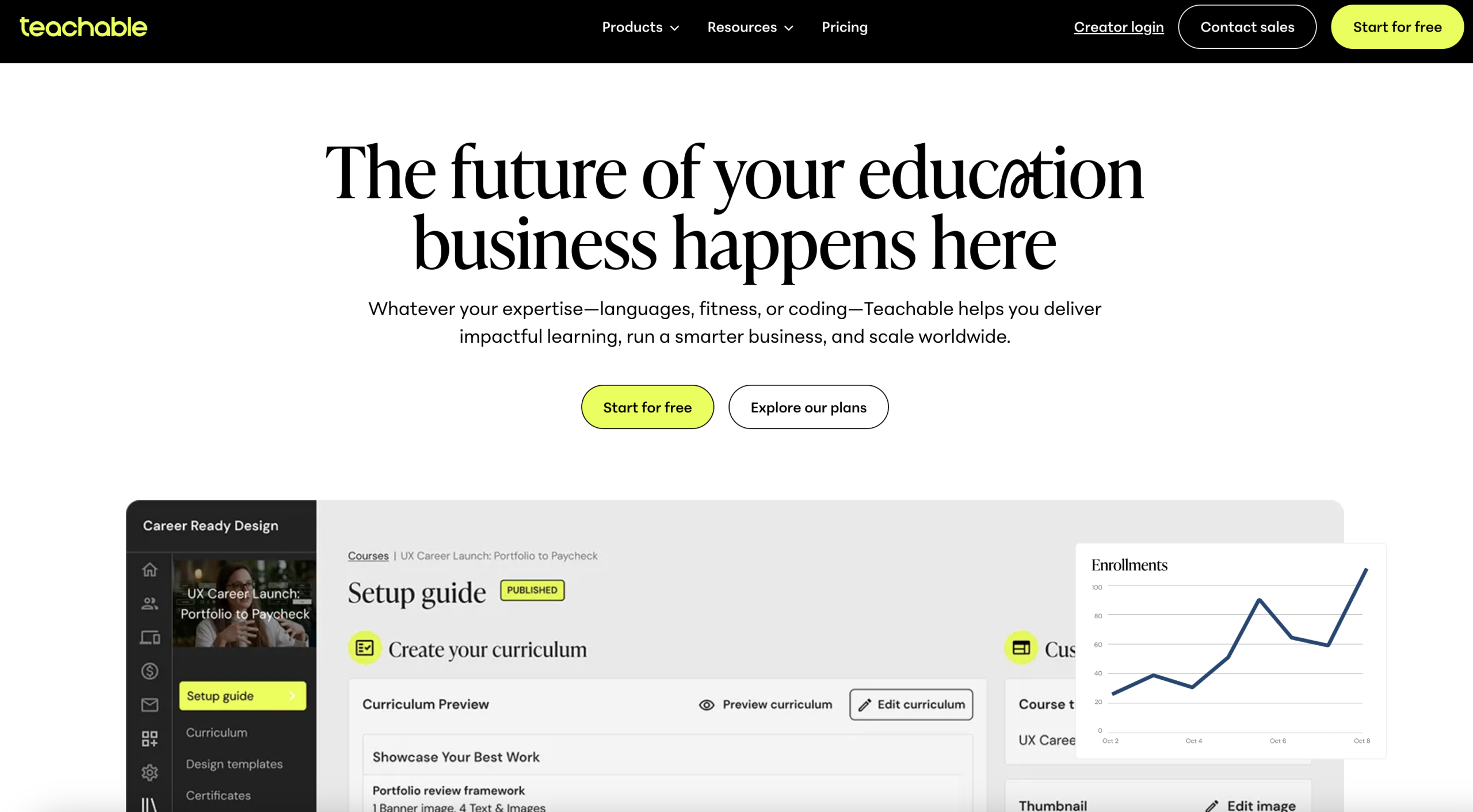
Teachable is one of the Whop alternatives that specializes in online courses only. It’s not an all-in-one platform like Whop or Payhip, so you’ll be limited to what you can sell. One of the biggest challenges with the platform is that it lacks built-in community-building features.
If you’re looking for a course creator only, it offers quizzes, completion certificates, student progress tracking, and built-in tools for student data and grading.
Unfortunately, it’s much more expensive than Whop as well, though. You’ll have to pay a monthly subscription. Plus, transaction fees for any sales you do get, especially on the Starter plan.
PRICING
Teachable has three pricing tiers and an enterprise plan. Overall, each pricing tier offers a more expansive set of features, so features are typically gated.
Starter Plan
-
- $39/month
- 7.5% transaction fee
Builder Plan
-
- $89/month
Growth Plan
-
- $189/month
PROS
-
- Has advanced features for course creation
- Allows you to customize your landing pages to your school’s branding
CONS
-
- Only a 7-day free trial, no free plan, more expensive than Whop
- Specialized in course creation, not an all-in-one tool for digital products
- Doesn’t have a marketplace to sell courses
- Lacks community elements that might be helpful to course creators
- Doesn’t offer 24/7 support like Whop
FAQ
What is similar to Whop?
Payhip is similar to Whop as it allows you to sell digital products, memberships, coaching services, software, physical products, and online courses. Plus, Payhip is considered an affordable option like Whop.
Is Whop still worth it?
Whop isn’t still worth it. There are so many tools on the market that offer similar features at more affordable prices, as Whop has a lot of fees associated with it. Whop also doesn’t have a built-in video tool and only allows YouTube or Vimeo embeds.
Does Whop actually pay out?
Yes, Whop does payout, actually. However, on average, it takes several days to pay customers. Plus, depending on your dispute rate, a percentage from 25%-50% will be held for 30 days, for 75% or higher, your funds will be held for 90 days, and your account is at risk of suspension.
Who is Whop’s biggest competitor?
Payhip is Whop’s biggest competitor, as they have a free plan with only a 5% transaction fee. Plus, it’s an all-in-one platform that allows you to sell anything from digital to physical products. On top of that, they have a marketplace where you can sell your products to an existing audience.


Payhip
Join over 130,000 creators who have launched their businesses selling digital products, online courses, memberships, coaching, and physical products.
Get started for free today
Comments
Leave a Comment