


6 Best Whop Alternatives to Make Money Online in 2026
Last updated: September 16, 2026
Whop is an online platform for selling online with various features such as building communities. In this guide, we’ll look at some of the reasons sellers are searching for Whop alternatives and compare 7 of the best Whop alternatives based on pricing, features, payouts, customer support, and the types of products you can sell.
Key Takeaways
- Payhip is best for selling digital products, courses, memberships, coaching, software, and physical products
- Shopify is best for selling physical products
- Podia is best for course creators and communities
- Patreon is best for recurring memberships and fan communities
- Etsy is best for handmade and craft sellers
- Teachable is best for online courses
Why Are People Leaving Whop and Looking for a Whop Alternative?
1. Payout Holds and Revenue Unpredictability
One of the biggest complaints from Whop sellers is having their payouts placed on hold. Whop may reserve some or all of your earnings if your account is considered higher risk, which can make it difficult to predict when you’ll actually have access to the money you’ve earned.
Whop’s reserve system is based partly on factors such as disputes, chargebacks, refunds, unusual transaction activity, and account verification. Depending on your risk score, Whop can hold anywhere from 25% to 100% of your balance for 30 to 90 days. In some circumstances, Whop’s Seller Terms allow funds to be held for up to 180 days.
Online reviews suggest that payout holds are a recurring frustration for some sellers. Several sellers report having their funds locked for weeks or months while their accounts undergo verification or review, with some describing unclear timelines for when their earnings would become available.
Whop says these measures are designed to protect against chargebacks, fraud, and other payment risks. However, if having predictable access to your sales revenue is important to your business, Whop’s reserve and payout policies are worth considering before you start selling.
2. More Fees Than You Might Expect
Whop doesn’t have one simple fee that covers everything. Instead, sellers can encounter different fees depending on how customers pay, how they withdraw their earnings, and which Whop services they use.
For example, Whop’s standard domestic card processing fee is 2.7% + $0.30 per successful transaction. International cards cost an additional 1.5%, while currency conversion adds another 1%.
There can also be additional fees for other services and payment methods, including:
- 1.5% for ACH payments, capped at $5
- 15% for transactions through financing partners
- $2.50 for next-day ACH payouts
- 4% + $1 for instant bank payouts
- 5% + $1 for crypto payouts
- 5% + $1 for Venmo payouts
- $23 for bank wire payouts
- $15 per dispute
- $29 per early dispute alert
- 0.8% for payment orchestration, when enabled
- 0.5% for billing
- 2% per transaction for Whop’s tax service when Whop calculates tax for you or collects and remits it
Not every fee applies to every transaction. But with so many different fees depending on payment method, payout method, location, currency, and the services you use, it can be surprisingly difficult to work out exactly how much Whop will cost you and how much of each sale you’ll actually keep.
If you prefer simple, predictable pricing and want to know exactly how much you’ll pay on each sale, Whop’s complicated fee structure may not be for you. There are a few other Whop alternative platforms that offer these extra perks such as automated tax handling and instant payouts without the extra fees that Whop charges.
3. Seller Verification Can Be Frustrating
Verification is a normal part of using payment platforms, but delays can become frustrating when they prevent you from accessing your account or earnings. Some Whop sellers report difficulties completing the platform’s verification process. Online reviewers describe problems uploading documents, lengthy verification times, and being asked to provide additional business information before they could continue using their accounts.
If you want to get your store up and running quickly, it’s worth considering what verification a platform requires and how easily issues can be resolved.
4. The Marketplace May Not Be Right for Your Niche
Whop has historically had a strong presence in niches such as trading and investing communities, sports picks and betting, reselling, Discord communities, make-money-online products, and business opportunities. Whop’s own historical sales data has identified reselling, trading, and sports picks among its top-selling digital product categories.
This doesn’t necessarily make Whop a bad marketplace, but it does mean you’ll want to consider whether its existing audience is the right fit for what you sell. If your products fall outside Whop’s most established niches, such as printables, craft patterns, design assets, ebooks, or educational resources, there are other platforms that may be better aligned with your target audience.
Before choosing Whop for its marketplace exposure, take a look at the products already selling there and consider whether the shoppers Whop attracts are the same people you want to reach.
5. Getting Human Support Can Be Difficult
Another frustration raised in Whop reviews is getting help when something goes wrong. Some reviewers report receiving automated or generic responses when trying to resolve issues with verification, payouts, or account restrictions. Others say they had difficulty reaching a human who could properly investigate their problem.
Automated support can be helpful for simple questions, but when your business or earnings are affected, you may want a platform where you can easily reach a real person for help.
| Platform | Best For | Pricing | Key Pros | Key Cons | Best Overall Verdict |
|---|---|---|---|---|---|
| Payhip | Creators selling digital products, courses, memberships, coaching, software, and physical products | Free: $0/month + 5% fee Plus: $29/month + 2% fee Pro: $99/month + 0% fee |
Low fees, built-in video player, marketplace access, supports many product types, affiliate/referral/upsell tools, VAT and tax handling | No built-in Discord or Telegram community | Best Whop alternative overall for flexibility, low fees, and built-in selling tools |
| Shopify | Traditional ecommerce stores, especially physical products | Basic: $39/month Grow: $105/month Advanced: $399/month Plus: $2,300/month |
Popular brand, large app ecosystem, many themes, strong for online store building | No free plan, extra fees from apps, weaker for digital products, more complex setup | Best for physical-product ecommerce, not ideal for creators selling digital goods |
| Podia | Course creators, digital downloads, coaching, webinars, communities | Mover: $33/month + 5% fee Shaker: $75/month |
Built-in video hosting, all-in-one creator tools, more built-in features than Whop | No marketplace, no free plan, can be expensive for beginners | Best for creators who want simplicity and built-in course tools |
| Patreon | Recurring memberships and fan communities | 10% platform fee + payment processing and extra fees | Strong brand recognition, community features, built-in video/livestreaming, email export | Expensive over time, limited discoverability, mainly for memberships | Best for fan-supported memberships, less ideal for broader product selling |
| Etsy | Handmade and craft sellers, some digital product sellers | Setup fee: $15–$29 Listing fee: $0.20/item Transaction fee: 6.5% Additional ad and payout fees may apply |
Large built-in audience, easy to set up, high customer trust | High competition, many fees, weak customization, not ideal for digital-first businesses | Best for marketplace exposure, but weaker for brand ownership and repeat marketing |
| Teachable | Creators focused only on online courses | Starter: $39/month + 7.5% fee Builder: $89/month Growth: $189/month |
Advanced course tools, quizzes, certificates, progress tracking | No free plan, expensive, course-only focus, lacks built-in community and marketplace | Best for course specialists who need deeper learning features |
6 Best Whop Alternatives to Make Money Online in 2026
1. Payhip
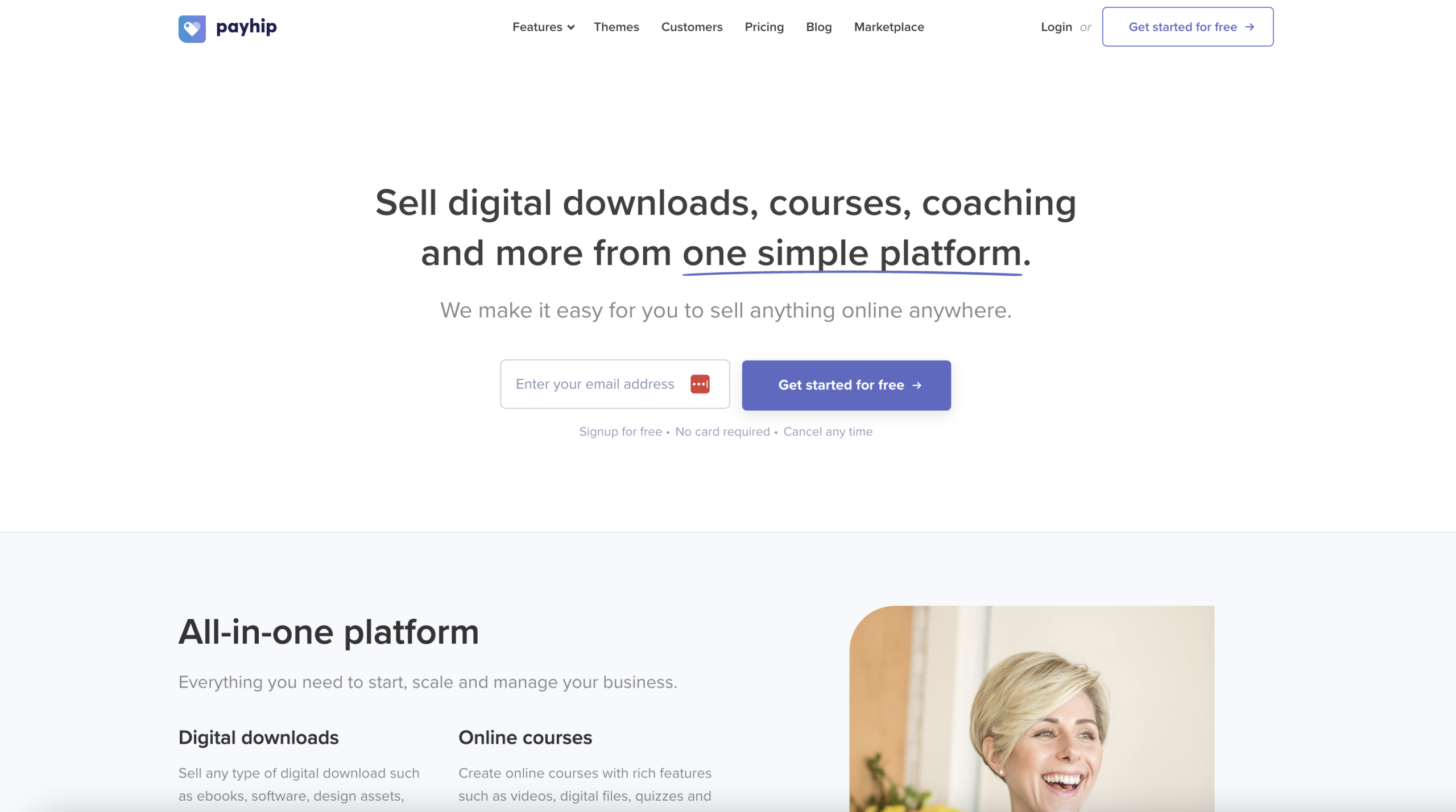
Payhip is the best Whop alternative for creators who want more straightforward pricing, instant payouts, automated tax handling, and real human customer support.
You can start selling on Payhip for free, with no monthly subscription or upfront fees. On the free plan, Payhip takes a 5% transaction fee when you make a sale. There aren’t extra Payhip fees for things like instant payouts or automated tax handling either, so it’s much easier to work out how much you’ll actually make from each sale.
You can also launch a fully branded website for free and customize it to match your business. Payhip supports both digital and physical products, so you can sell everything from ebooks, templates, and online courses to memberships, coaching, software, and physical goods.
Payhip also has a marketplace specifically for digital products, and there are no additional fees to publish your listings there. You’ll still have your own fully customizable storefront, so you’re not relying on the marketplace to make sales.
If you sell online courses, Payhip has a built-in course platform and video player. You can upload your videos directly, drip lessons over time, create quizzes and assignments, and give students certificates when they complete your course.
Payhip also takes care of a big headache for sellers: taxes. It automatically calculates, collects, and remits applicable VAT in the EU and UK and sales tax in the US and Canada, so you don’t have to handle it all yourself.
PRICING
Payhip offers simpler and more predictable pricing than Whop. While Whop charges different fees depending on payment methods, payouts, and services used, Payhip has three straightforward pricing plans with clearly defined transaction fees.
Payhip’s Free plan lets you start selling without paying a monthly subscription. As your sales grow, you can upgrade to reduce or completely remove Payhip’s transaction fee. Payhip provides unlimited access to all of its features on every pricing plan, along with unlimited products and unlimited revenue.
You’ll have the option to choose between three pricing plans:
-
- Free Plan: $0/month, 5% fee per sale (perfect for beginners)
- Plus Plan: $29/month, 2% fee per sale
- Pro Plan: $99/month, no transaction fees
PROS
-
- Most affordable Whop alternative
- Less competitive marketplace to Whop
- Built-in features for selling digital and physical products, such as:
-
- Digital downloads: PDF stamping on ebooks to prevent piracy
- Online courses: built-in course player, unlike Whop, multiple lesson types, certificates for students
- Coaching: Calendly and Zoom integrations for scheduling meetings and hosting video calls
- Subscription of membership: charge recurring fees to members when sharing exclusive content
- Software: generate license keys or upload your own
- Physical products: easily manage inventory and order fulfillment
-
-
- Get instant payouts with PayPal and Stripe, or choose from over 10 other payment gateways
- No minimum payout thresholds and no payout holds
- Collaborate with up to 4 other creators to launch your products
- Access easy-to-use marketing tools, such as an affiliate program, referral system, upselling, cross-selling, coupon codes, and more
CONS
-
- Doesn’t have built-in Discord or Telegram communities as a channel
Sell Digital Products with Payhip
No monthly fees. No tech headaches.
2. Shopify

Shopify is one of the most popular platforms for building an online store, making it a common Whop alternative to choose from. They own a marketplace called Shop where you can sell your products to a global audience. However, since there are millions of sellers on the platform, the marketplace can get quite crowded, reducing your visibility.
Shopify also doesn’t have a free plan, so you’ll be on the hook of paying a subscription even if your store doesn’t make any sales. They’re also known to have high fees, particularly due to the fact that they have an app store, instead of building in more features natively into the product. Plus, you’ll likely have to pay for a theme if you want one with a good design.
The biggest disadvantage to using Shopify as a Whop alternative is that they don’t have features built-in for selling digital products. You’ll need to install a third-party app to do so, which can drastically increase your overall fees, thus, reducing profitability.
PRICING
On Shopify, you’ll have the option to choose from four pricing plans. These are USD prices as of March 26, 2026.
Basic Plan:
-
- $39/month
- 2.9% + $0.30 online
- 2.6% + $0.10 in person
- 2% 3rd-party payment providers
Grow Plan:
-
- $105/month
- 2.7% + $0.30 online
- 2.5% + $0.10 in person
- 1% 3rd-party payment providers
Advanced Plan:
-
- $399/month
- 2.5% + $0.30 online
- 2.4% + $0.10 in person
- 0.6% 3rd-party payment providers
Plus Plan:
-
- $2,300/month (on a 3-year term)
PROS
-
- Offers 800+ themes to help you customize your own online store
- Owns a marketplace where you can sell products online called Shop
- Has all the tools you need to run your online store, particularly through add-on apps
CONS
-
- Primarily known for selling physical products, not a good platform for digital products
- Fees can skyrocket quickly when adding apps from the app store to your website
- Charges additional transaction fees when not using Shopify Payments
- Harder to set up and build an online store
- Lacks built-in features for building a community or membership site
3. Podia

Whop alternatives like Podia allow you to sell online courses, digital downloads, coaching, webinars, and build a community. Podia is a more expensive platform than Whop as you’ll have to pay both a subscription and a transaction fee on its lowest plan, making it a subpar choice for beginners.
Podia has built-in video hosting that allows you to have online courses on your website without needing to embed YouTube or Vimeo videos. Overall, you’ll find more built-in features on the platform as it’s more of an all-in-one tool.
However, this Whop alternative doesn’t have its own marketplace, unlike other Whop alternatives. Thus, you’ll really need to work on enhancing those marketing skills to help you achieve the sales volume you’re after.
PRICING
Podia has only three pricing plans. Unfortunately, they don’t currently have a free plan. They only have a 30-day free trial to test out the platform. However, if you don’t make a sale in your first thirty days, you’ll still be on the hook for paying a monthly subscription that tends to be a bit on the higher side. Here’s a look at the three plans, which were recently increased:
Mover:
-
- $49/month
- 5% transaction fees
Shaker:
-
- 99/month
Earthquaker:
-
- $179/month
PROS
-
- Offers a greater selection of design options for storefronts
- Podia is more affordable than Whop once you’ve achieved high sales volume
- Includes a built-in video player for online courses
CONS
-
- An expensive platform for beginners
- Limited design flexibility
- Lacks an affiliate marketing program on the Mover plan
- Lacks strong integration with Discord and Telegram
- Doesn’t have software license keys or cryptocurrency offerings
4. Patreon

If you’re looking to create a membership platform for your fanbase, you might want to check out Whop, an alternative to Patreon. It’s a bit pricier than Whop; however, it’s a popular choice among content creators.
On this platform, you’ll be able to build a community via chats, DMs, and comments. You can also export your email lists to send emails to your community and keep them engaged. The platform also has built-in video and livestreaming. If you’re a podcaster, you can manage your podcast on the platform.
However, this Whop alternative has few options available for creators to get discovered. You’ll need to grow your own followers on another platform and bring them over to the platform.
PRICING
Patreon only has one price on its platform. It’s a transaction fee that doesn’t decrease with the volume of members. Unfortunately, this can make it much more expensive than Whop, particularly for building a community.
Patreon Pricing:
-
- 10% of the income you earn on Patreon
- 2.9% + $0.30 USD for payment processing, which can vary per payment gateway
- 2.5% currency conversion fee
- $0.25- 1% payout fee
- 30% on eligible purchases made on Patreon’s iOS app
PROS
-
- Allows for more customization than Whop
- Has more brand recognition than Whop
CONS
-
- Designed for recurring memberships only
- Most creators struggle to transition members from the free tier to the paid one
- Lacks tools for discoverability
- No native community features, such as integrated Discord or Telegram
- Primarily for monthly billing; lacks more flexible pricing options
5. Etsy
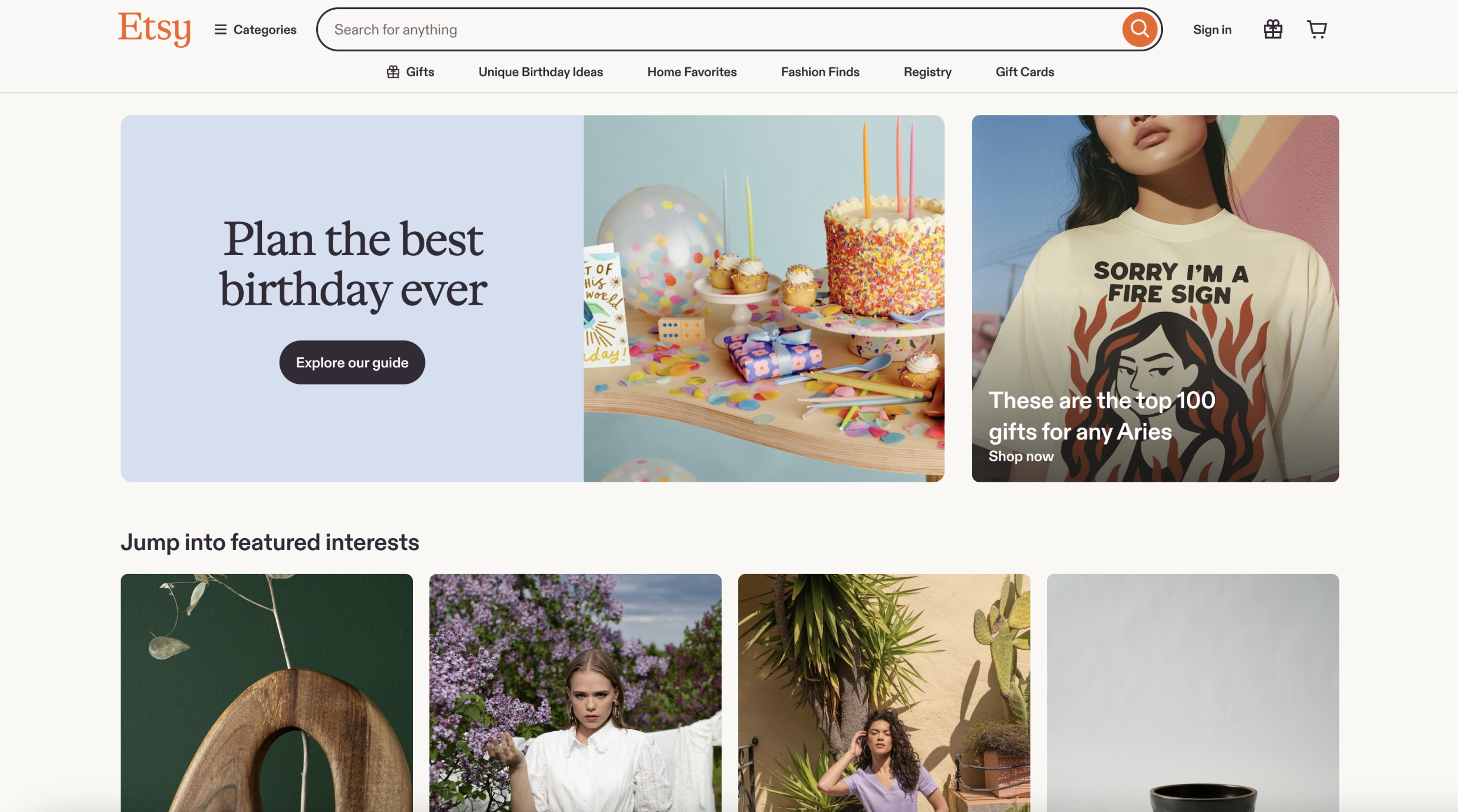
Etsy is a popular marketplace known for its handmade goods, but allows people to sell their digital products on the platform as well. Due to its mass appeal, it has higher fees than most platforms, making it an expensive Whop alternative.
Etsy has a lot of brand recognition that makes shoppers feel safe shopping on their website. Their marketplace boasts millions of shoppers, though the numbers are decreasing year over year.
PRICING
Etsy charges higher fees than most ecommerce storefronts. The biggest issue people have with the pricing is the listing fees per item to keep your products live, which expire every four months. Plus, there are set-up fees, which most Whop alternatives don’t charge.
Etsy Fees:
-
- $15-$29 USD set-up fee
- $0.20 USD listing fee, which expires every four months
- 6.5% transaction fee of the display price
- 12%-15% per sale for offsite ads
- $10/month USD subscription fee for sellers in good standing
- $0.20 transaction fee for in-person selling fees via Square reader
- 1% for instant payout
- $15/month USD for pattern fees
- 2.5% currency conversion fee
PROS
-
- Etsy has a massive built-in audience to sell to
- Easy to set up a shop without coding skills
- Customers trust the brand
CONS
-
- Not the best platform for selling digital products; mostly known for it’s physical products
- High marketplace fees; charges listing fees unlike Whop
- High marketplace competition
- Limited store customization; hard to stand out on the platform
- Can’t build an email list, run retargeting ads, or retain customers
6. Teachable
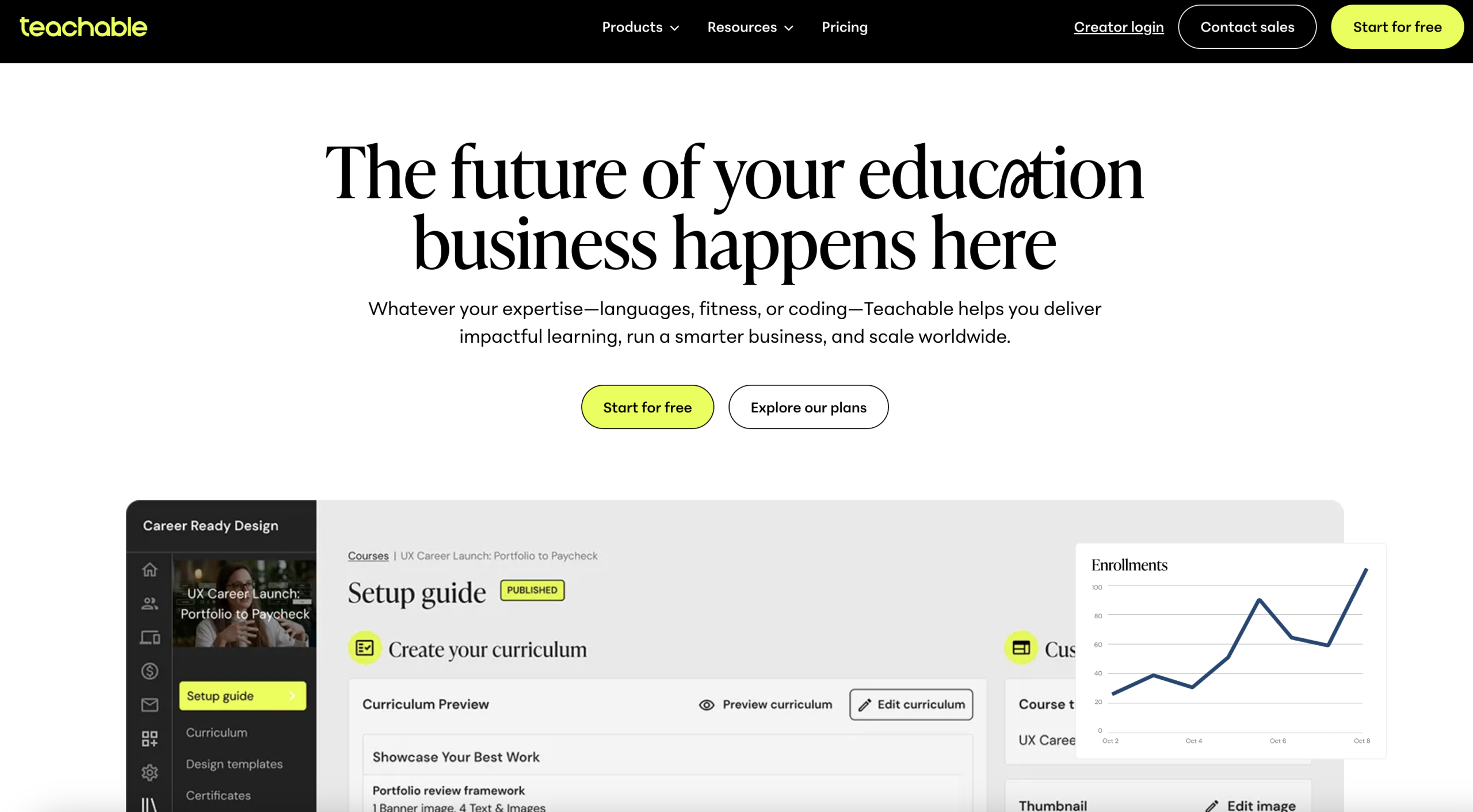
Teachable is one of the Whop alternatives that specializes in online courses only. It’s not an all-in-one platform like Whop or Payhip, so you’ll be limited to what you can sell. One of the biggest challenges with the platform is that it lacks built-in community-building features.
If you’re looking for a course creator only, it offers quizzes, completion certificates, student progress tracking, and built-in tools for student data and grading.
Unfortunately, it’s much more expensive than Whop as well, though. You’ll have to pay a monthly subscription. Plus, transaction fees for any sales you do get, especially on the Starter plan.
PRICING
Teachable has three pricing tiers and an enterprise plan. Overall, each pricing tier offers a more expansive set of features, so features are typically gated.
Starter Plan
-
- $39/month
- 7.5% transaction fee
Builder Plan
-
- $89/month
Growth Plan
-
- $189/month
PROS
-
- Has advanced features for course creation
- Allows you to customize your landing pages to your school’s branding
CONS
-
- Only a 7-day free trial, no free plan, more expensive than Whop
- Specialized in course creation, not an all-in-one tool for digital products
- Doesn’t have a marketplace to sell courses
- Lacks community elements that might be helpful to course creators
- Doesn’t offer 24/7 support like Whop
FAQ
What is similar to Whop?
Payhip is similar to Whop as it allows you to sell digital products, memberships, coaching services, software, physical products, and online courses. Plus, Payhip is considered an affordable option like Whop.
Is Whop still worth it?
Whop isn’t still worth it. There are so many tools on the market that offer similar features at more affordable prices, as Whop has a lot of fees associated with it. Whop also doesn’t have a built-in video tool and only allows YouTube or Vimeo embeds.
Does Whop actually pay out?
Yes, Whop does payout, actually. However, on average, it takes several days to pay customers. Plus, depending on your dispute rate, a percentage from 25%-50% will be held for 30 days, for 75% or higher, your funds will be held for 90 days, and your account is at risk of suspension.
Who is Whop’s biggest competitor?
Payhip is Whop’s biggest competitor, as they have a free plan with only a 5% transaction fee. Plus, it’s an all-in-one platform that allows you to sell anything from digital to physical products. On top of that, they have a marketplace where you can sell your products to an existing audience.


Payhip
Join over 130,000 creators who have launched their businesses selling digital products, online courses, memberships, coaching, and physical products.
Get started for free today
Comments
Leave a Comment